Inconsistent lead flow and decision-makers ghosting after the first meeting define the MSP sales cycle. Email is not a passive newsletter; it is your most powerful, automated pipeline for lead nurturing, client upsells, and reactivation. This is a system built on trust and timing, designed specifically to target prospects during their "marketable moments." Stop adopting the failure modes of generic vendors and build a structured, high-conversion MSP Email Marketing framework. We diagnose common structural failures and focus entirely on creating predictable outcomes. The foundation of this system starts with proper segmentation and compelling offers.
Key Takeaways
- A list of 500 ICP-matched decision-makers beats a list of 5,000 bad fits; segment prospects, warm leads, referral partners, and existing customers into separate buckets.
- Map offers to marketable moments (new compliance rules like CMMC, a security incident, new IT leadership) and use a low-friction CTA such as replying 'ASSESS' for a 15-minute diagnostic.
- Run three core campaigns: Nurturing (3 to 5 emails over 10 to 21 days), Re-engagement (3 emails over 4 to 6 weeks), and Customer Expansion (monthly digest plus quarterly offer).
- Protect deliverability with one SPF record, DKIM on every sending platform, and DMARC starting at p=none, plus list hygiene and domain warming before cold outreach.
- Wire email engagement into the CRM so a click or reply instantly flags an MQL and triggers an Account Executive task, cutting time-to-follow-up on warm leads.
MSP email marketing is a system that segments IT buyers by role, trigger, and lifecycle, then sends timed nurture, re-engagement, and expansion campaigns tied to compliance and security moments. It runs on authenticated deliverability and a CRM connection so every click or reply drives a tracked sales action rather than a one-off newsletter.
1. Strategic List Segmentation: Building the ICP-First Pipeline
For effective MSP Email Marketing, stop chasing the vanity metric of total list size. A list of 500 decision-makers is infinitely more valuable than 5,000 bad fits. The foundation of a predictable pipeline is rooted in list quality and proper segmentation filtered by your Ideal Customer Profile (ICP).
Your list universe must segment four distinct buckets: prospects, warm leads, referral partners, and existing customers, kept strictly separate. Apply ICP filters based on high-value indicators critical for MSP growth: compliance pressure (HIPAA/CMMC), technical stack complexity, size, and multi-site operations.
Ensure 100% permission by focusing only on opt-in sources you control (webinar registrations, downloadable checklists, security assessments) for cleaner data. Segmentation then becomes the operating blueprint:
- By Role: CEO/CFO (ROI/budget focus) vs. IT Manager (technical specifications).
- By Trigger: Identified need (ransomware scare, upcoming M365 migration).
- By Lifecycle: New lead, warm opportunity, or active customer (upsells).
The CEO control metric is the percentage of your list actively mapped to your ICP segments, ensuring every deployed message contributes directly to revenue growth.
2. Mapping High-Value Offers to Marketable Moments
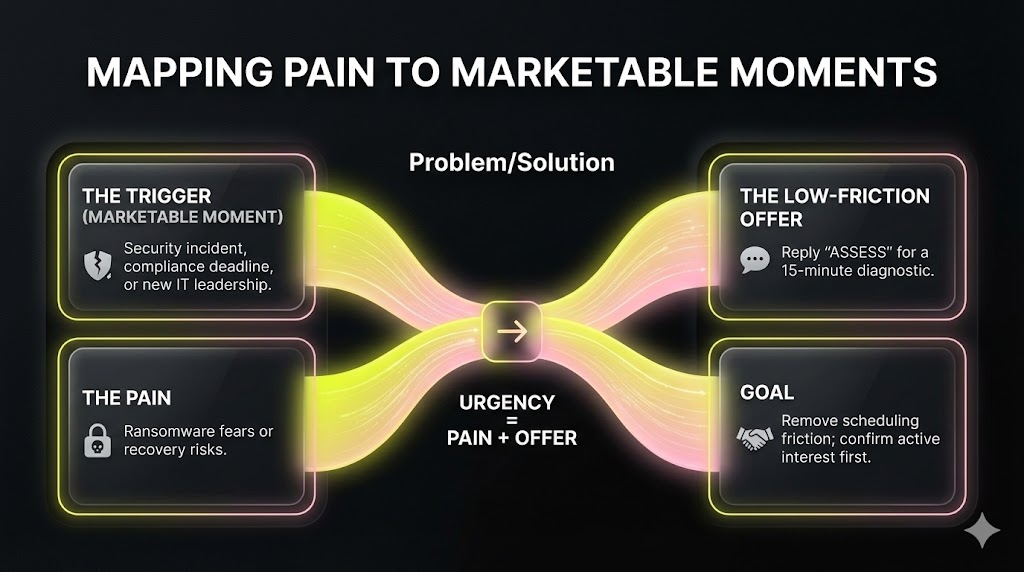
If your MSP Email Marketing outreach feels ignored, it is often a matter of timing. Generic marketing fails because it targets a static profile, ignoring "marketable moments", critical shifts that create urgency. These triggers include new compliance rules (like CMMC), major security incidents, or the arrival of new IT leadership looking to make an early impact. Map your offers directly to these pressures using CEO-friendly, outcome-based deliverables, not technical features.
Map Pain to Low-Friction Offer:
- Security Risk: Phishing-Resistant Identity Posture Check or Security Readiness Assessment.
- Recovery Fears: Backup and Disaster Recovery (BDR) Readiness Review or Cloud Migration Risk Assessment.
The goal is a low-friction next step. Use a minimal email CTA: “Reply with ‘ASSESS’ for a free 15-minute diagnostic call.” This removes scheduling friction. Only escalate to a full-scale assessment once this low-barrier engagement confirms active interest.
3. Structuring Your Three Core Revenue Engine Campaigns
Predictable pipeline growth requires an operationalized campaign portfolio that covers the full revenue lifecycle (net-new, revival, and expansion). Existing clients represent your highest conversion potential. Structure your MSP Email Marketing around these three essential campaign types:
| Campaign Type | Primary Goal | Delivery Cadence |
|---|---|---|
| Nurturing | Convert opt-ins into qualified warm leads. | 3 to 5 educational emails over 10 to 21 days. |
| Re-engagement | Revive cold leads or dormant MQLs. | 3 value-driven emails over 4 to 6 weeks. |
| Customer Expansion | Upsell/cross-sell new services (highest potential). | Monthly insight digest + quarterly targeted offer. |
Frequency Rule: Always start with a low cadence. Earn the right to increase volume based strictly on measured engagement and positive click-through rates.
The Essential “Do Not Do This” Checklist
Avoid structural flaws that destroy engagement: sales-only blasts, confusing CTAs, and mailing contacts without prior consent (spamming). Focus on delivering utility, not sheer volume.
4. Operational Templates: Plug-and-Play Email Sequence Frameworks
Effective MSP Email Marketing requires ready-to-deploy frameworks tied directly to core revenue lines: managed security, cloud, and backup. These revenue-specific templates eliminate the blank page problem, allowing for immediate delegation.
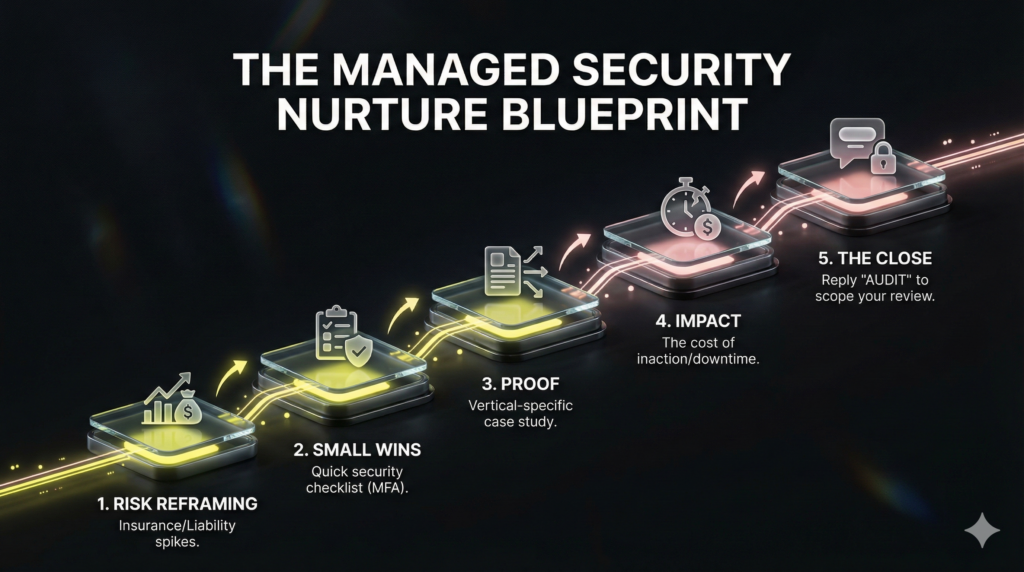
Template A: 5-Email “Managed Security” Nurture
This sequence addresses compliance urgency and the cost of inaction, driving prospects toward a security assessment.
- Risk Reframing: Detail shifting buyer realities (e.g., regulatory deadlines or insurance liability spikes).
- Small Wins: Deliver instant value with a checklist of quick security wins (like enforcing MFA).
- Case Study: Use a vertical-specific Before/After format demonstrating measurable security event reduction.
- Cost of Inaction: Detail the financial impact of downtime, recovery expenses, and potential fines.
- Assessment CTA: Close with a low-friction call: “Reply ‘AUDIT’ to scope your Security Posture Review.”
Template B & C: Cloud and Re-engagement
These sequences target high-spend moments and revive dormant leads.
- Template B (3-Email Cloud Migration): Address common blockers (cost overruns, governance issues) by offering a structured consultation to simplify hybrid environment complexity.
- Template C (3-Email Re-engagement): Revive cold contacts by leading with value (industry insight, high-value video) before a final low-friction check-in.
Crucially, every email must include the minimum personalization standard: the recipient's role and one relevant industry trigger (e.g., “Given the CMMC changes…”).
5. Operationalizing Your Deliverability Firewall: Authentication & Hygiene
Deliverability is not a marketing preference; it is a critical growth constraint. Spam placement kills your pipeline invisibly. Operationalize a strict authentication and hygiene checklist to protect revenue streams by ensuring messages land in the inbox, not the junk folder.
Authentication Essentials (The Foundation)
Your domain’s DNS records act as the first line of defense:
- SPF (Sender Policy Framework): Maintain only one SPF record per domain to prevent parsing failures and explicitly authorize your sending platforms.
- DKIM (DomainKeys Identified Mail): Enable signing for every platform sending on your behalf. DKIM confirms the message has not been tampered with in transit.
- DMARC (Domain-based Message Authentication): Implement DMARC immediately. Start at
p=nonefor monitoring; escalate to quarantine/reject only when MSP Email Marketing alignment is 100% verified.
List Hygiene and Risk Mitigation
Protect domain reputation through strict list hygiene: automatically remove hard bounces, suppress unengaged contacts, and verify outbound lists. New domains require mandatory domain warming before cold outreach deployment to prevent immediate reputation flatlining. If open rates crash, check your DNS authentication status, content spamminess, and sending volume changes immediately.
6. Integrating Email Engagement with Sales: Automating Pipeline Action
The structural failure in MSP Email Marketing is treating the platform as an island. True pipeline acceleration requires clicks, replies, and content downloads (like a Security Assessment) to immediately trigger actionable changes in your CRM or PSA. Operational failure occurs when sales is unaware of engagement for 48 hours. The core principle: every email interaction must be a system-driven instruction for sales.
Minimal integration outcomes are essential for converting marketing activity into real pipeline movement:
- Contact Lifecycle Updates: High-value engagement instantly shifts a prospect to Marketing Qualified Lead (MQL) or warm lead.
- Automated Tasks and SLA: MQL status triggers an Account Executive (AE) task and activates the internal follow-up Service Level Agreement (SLA).
- Opportunity Attribution: Ensure the specific campaign is tied to the resulting opportunity for accurate ROI calculation and reporting.
Segmentation must be driven dynamically by these immediate system actions, whether by service interest (security vs. cloud) or contact source. The critical CEO metric here is the measurable reduction in time-to-follow-up on warm leads, and the direct conversion rate from MQL to a booked meeting. Integrate your systems to enforce process and stop running blind.
The Tool Categories Behind an MSP Email Marketing System
You do not need more tools, you need one clean stack where each category has a clear job and the data flows between them. Before you compare specific vendors in 2026, decide which of these categories your MSP actually needs, then pick the lightest option that connects to your CRM. Naming the category first keeps you from buying overlapping platforms that fragment your pipeline.
- Email service provider or marketing automation platform: The engine that sends sequences and holds your segments. Options range from lightweight senders like Mailchimp to automation-first platforms like ActiveCampaign or HubSpot. Choose on how well it syncs with your CRM, not on feature counts.
- CRM and PSA: The system of record for contacts and opportunities. Most MSPs already run ConnectWise or Autotask for service and pair it with a marketing CRM, so email engagement must write back to whichever holds your pipeline.
- Deliverability and authentication tooling: DNS and monitoring for SPF, DKIM, and DMARC, plus reputation and inbox-placement checks. This category protects the whole system, so treat it as mandatory, not optional.
- List verification and hygiene: Bounce checking and email verification that runs before every send to keep hard bounces and spam traps off your domain reputation.
- Analytics and attribution: Whatever ties a campaign to a booked meeting and revenue, whether native platform reporting or your CRM dashboards. Without it you cannot prove ROI to a buyer or a board.
Growing the list that feeds these tools is its own discipline, covered in the MSP email list building guide, and email should plug into your wider MSP lead generation strategies so nurture is one channel in a full pipeline, not an island.
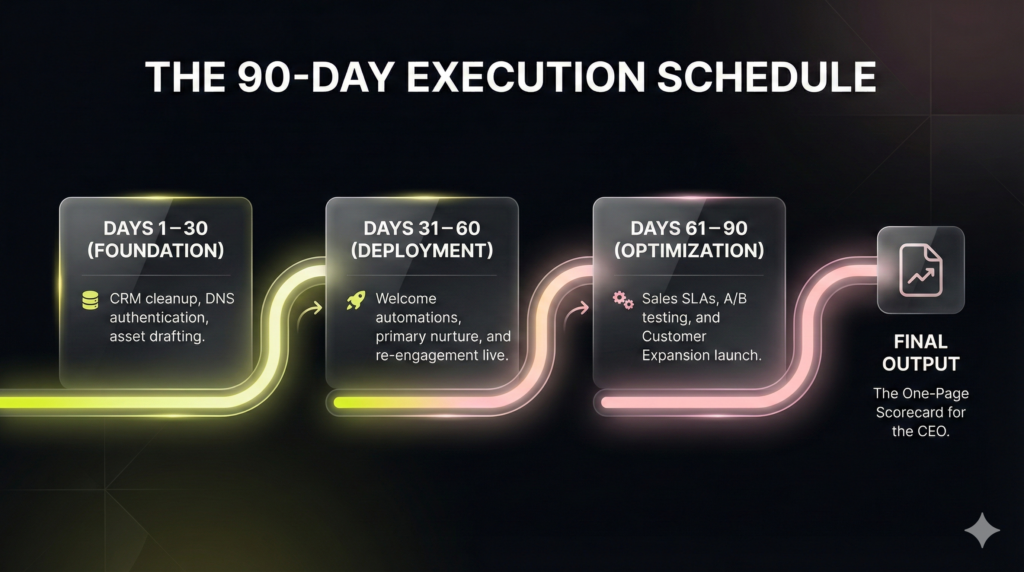
The 90-Day Execution Schedule for MSP Email Marketing System Implementation
The MSP email pipeline succeeds through process integrity, not magic. Use this 90-day schedule to transition from theoretical strategy to a fully operational, revenue-generating system. This plan requires executive oversight but demands operational delegation. Move from manual effort to automated lead flow, creating predictable outcomes aligned with your Ideal Customer Profile (ICP).
Prerequisites: Establish Your Launchpad (Completed Before Day 1)
Do not deploy email until these foundational steps are complete.
- Define ICP and Offers: Finalize 2 to 3 high-value deliverables (e.g., Security Assessment, Cloud Readiness Review) that target your ICP’s "marketable moments."
- Enforce Authentication: Implement SPF, DKIM, and DMARC monitoring across all sending domains to protect deliverability and reputation.
- Configure CRM Fields: Ensure the CRM tracks contact lifecycle stages (Prospect, MQL, Customer) and specific service interest (Security, Cloud, BDR) using clean, dedicated fields.
Days 1 to 14: Foundation and Asset Creation
- Inventory and Audit: Identify and map all current sending sources (CRM, marketing automation, invoicing). Suppress contacts without explicit opt-in.
- Build Core Segments: Create a minimum of three active, dynamic segments tied to your ICP and immediate service interest triggers.
- Draft Value-First Content: Outline the content calendar. Assign drafts focusing on utility and education (80%) over direct pitching (20%). Refocus messaging on reframing risk, not selling technology.
Definition of Done: Three active segments built; content calendar approved; sending domain health verified.
Days 15 to 45: Core Flow Deployment
- Deploy Welcome Automation: Launch a simple 3 to 5 email Welcome/Onboarding sequence for new opt-ins. Set engagement expectations and reinforce trust.
- Launch Primary Nurture: Select your highest-value offer (e.g., Managed Security) and deploy the 5-Email Nurture Template. Configure the sequence to run on autopilot.
- Activate Re-engagement: Launch the 3-Email Re-engagement flow targeting MQLs dormant for 90+ days. This revives cold pipeline contacts.
Definition of Done: Three core automations are running; initial engagement metrics are logged.
Days 46 to 75: Instrumentation and Sales Alignment
- Define Warm Lead Thresholds: Formalize the score or actions promoting a contact to Marketing Qualified Lead (MQL) (e.g., Click + Pricing Page View + Reply). Codify this MQL definition in your CRM/PSA system.
- Automate Sales Tasks: Integrate email tracking so an MQL event immediately triggers an automated task or ticket for the assigned Account Executive (AE).
- Establish Sales SLA: Enforce an internal Service Level Agreement (SLA). Example: “All MQLs must receive personal follow-up within 4 business hours.”
- Implement A/B Testing: Design and launch A/B tests on two key variables: subject line hooks (ROI versus Risk) and primary call-to-action language.
Definition of Done: MQL definition automated; sales reporting active; initial A/B test underway.
Days 76 to 90: Optimization and Scale
- Review and Iterate: Conduct a 60-day review of all active campaigns. Apply the Kill/Keep/Iterate rule based on deliverability, engagement rate (CTR), and meetings booked.
- Deploy Customer Expansion: Activate your highest potential revenue stream. Launch a quarterly targeted campaign focusing on upsells (e.g., Compliance as a Service) to existing, engaged clients.
- Scale High Performers: Allocate budget and resources toward creating three additional content pieces for the nurture sequence that delivered the best conversion metrics.
Definition of Done: Optimization strategy defined; Customer Expansion campaign live; system ROI attributable.