The referral wall is inevitable. MSP leadership needs a predictable pipeline, but relying on generic, high-volume outreach often sacrifices brand trust and deliverability. That approach is fatal in the high-stakes world of IT security. You do not need a blast; you need a repeatable, targeted system. This article outlines a proven 10-step Cold outreach for MSP methodology, integrated into mapping the B2B customer journey, designed to generate qualified meetings consistently while safeguarding your reputation. We begin where all effective growth starts: establishing a profitable niche and Ideal Customer Profile (ICP).
MSP cold outreach is the practice of contacting IT decision-makers who have never engaged with your firm, using a warmed sending domain and a low-friction offer to start a conversation. Done well it books qualified meetings without burning your reputation or your primary domain.
Key Takeaways
- Effective MSP cold outreach targets realistic benchmarks of an 8 to 15% reply rate and a 1 to 3% meeting-booked rate, prioritizing conversion and domain health over open rates.
- Never send from your main website domain. Use a separate sending domain warmed for 2 to 4 weeks, starting near 30 emails per mailbox per day and scaling by adding inboxes.
- The person titled IT Manager rarely holds the budget in SMBs. Map your offer to the COO, CFO, or owner depending on company size, and include the Compliance Officer in regulated verticals.
- Lead with a low-friction micro-audit that takes 15 to 30 minutes, such as an M365 security baseline check, rather than pitching a year-long managed services contract.
- A 3-step sequence over 7 days (relevance plus offer, proof plus insight, then polite breakup) starts a conversation and protects sender reputation.
1. Define the ICP Wedge: Vertical Focus and Marketable Moments
The MSP market is saturated; pitches for generic ‘managed IT’ are read as commodity spam and deleted without urgency. Successful Cold outreach for MSP requires defining a specific wedge, a combination of a focused Ideal Customer Profile (ICP) and a compelling marketable moment. That converts a broad market into an addressable, relevant list.
Define your ICP by segmenting the market: specify the industry (e.g., medical clinics, regional manufacturers), employee size band (25 to 75 employees), service radius, and current IT state (break-fix or internal support). The marketable moment is the external factor, new compliance mandates, leadership transition, or a recent security incident. That compels immediate action.
Leverage these specifics to craft two highly specific, reusable sentences for your emails:
- ICP Statement: "We target orthopedic groups with 4-8 locations in the Dallas metro area currently using internal or break-fix IT."
- Why Now: "The HIPAA Omnibus rule changes mandate specialized access auditing, which is currently a gap in your environment."
2. Pinpoint the Budget Owner: The Real Decision-Makers for MSP Cold Outreach
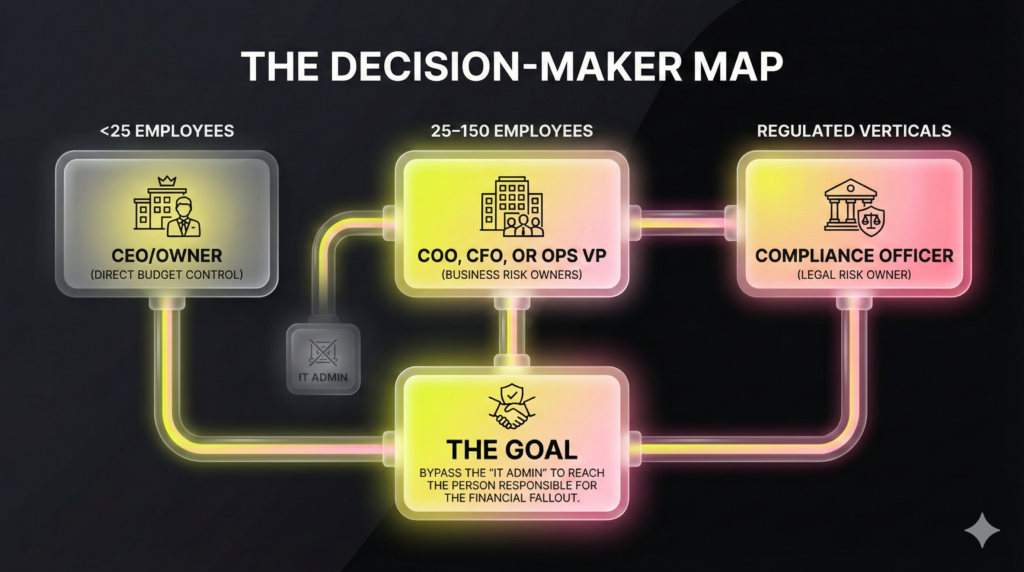
Your cold outreach for MSP fails when it reaches an influential contact who lacks purchasing authority. In the SMB market, the person titled “IT Manager” rarely controls the budget. To bypass gatekeepers and ensure your message reaches the authorized risk owner, systematically map your offer to the primary decision-maker:
- <25 Employees: Owner/CEO (CC Office Manager for logistics).
- 25 to 150 Employees: COO, CFO, or Operations VP. The internal "IT Admin" is an influential source of technical data, not the final budget owner.
- Regulated Verticals (Finance, Healthcare): Compliance Officer or Admin Leader must be included, as they own the legal risk associated with non-compliance.
Determine the primary persona based on the specific problem you solve. For uptime guarantees or disaster recovery, target Operations. When pitching security audits or regulatory compliance, target the Owner or CFO. They are directly responsible for the financial and legal fallout.
3. Establish Domain Hygiene to Isolate Sender Reputation Risk
The primary risk of Cold outreach for MSP is domain contagion: a single aggressive campaign can burn the primary domain used for client communication. Treat deliverability like security hygiene to protect this vital business asset.
Never use your main website domain (e.g., yourcompany.com). Instead, establish a separate, dedicated sending domain (e.g., getyourcompany.com or yourcompanyleads.com).
Warm the new domain for 2 to 4 weeks, ramping volume gradually. Start with low daily volumes (~30 emails per mailbox per day) and scale horizontally by adding inboxes, rather than spiking volume on a single account.
Verify all emails before sending, and pause outreach immediately upon high bounce or complaint spikes. Ignore noisy open rates; focus on reply rates, meeting rates, and strict monitoring of bounce and complaint trends within a comprehensive MSP email marketing system.
4. Deploy the Low-Friction Offer: Selling the Micro-Audit
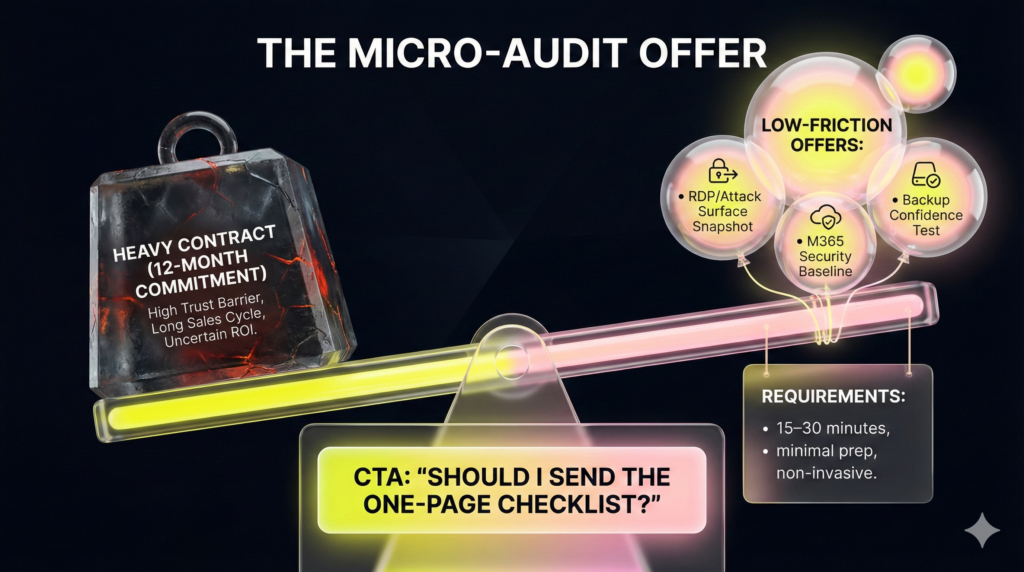
Cold outreach for MSP fails until it overcomes the trust barrier inherent in asking for access to critical systems, necessitating a zero-trust marketing approach. Do not sell a year-long managed services contract in the first email.
Instead, offer a low-friction offer: a micro-audit promising a specific, high-value outcome with minimal commitment. It must take 15 to 30 minutes, require little prospect prep, and tie directly to their immediate "Why Now" moment.
The offer must provide instant, actionable clarity. Strong examples include:
- RDP/Attack Surface Snapshot: Quick, non-invasive check of external access points.
- M365 Security Baseline Check: Rapid review of core Microsoft 365 security settings.
- Backup Restore Confidence Test: A 30-minute review focused on recovery time objectives.
End initial outreach with a clear credibility signal: mention a local client or use a short proof line (e.g., "We helped a local clinic finalize HIPAA readiness gaps in under 48 hours"). This minimizes risk and maximizes meeting conversion.
5. Structure Your Cold Outreach for MSP Emails for Brevity and Relevance
The most effective Cold outreach for MSP respects the recipient’s time. If your email requires scrolling, it fails. Condense your value proposition and low-friction offer into five to seven punchy lines, focusing strictly on relevance and outcome.
Immediately establish context. For example: "If you operate a regional accounting firm preparing for tax season, the fallout of a system failure is measured in unrecoverable fines and client trust." This connects your service directly to their immediate financial risk.
Add proof by referencing a specific, quick outcome, avoiding vague competence: "We helped a local firm eliminate 90% of their critical security alerts last month." End with a low-pressure CTA, a specific binary choice requiring less than 60 seconds of their time. This maximizes immediate conversion by focusing on the recipient's anxiety.
Mini-Template Pattern:
- Subject Line: Quick Compliance Check for [Vertical] in [Town]
- First Sentence: Are your team’s current configurations aligned with the new [Regulatory Mandate]? We offer a 20-minute M365 baseline check to flag immediate risk areas for SMB owners. Should I send over the one-page prep checklist?
6. Use Deep Personalization to Justify the Intrusion
To move beyond commodity cold outreach for MSP, skip baseline personalization (name/company). Instead, use three tiers that connect your service to a current business imperative:
- Tier 1 (Baseline): Merge fields (Name/Company). Zero value.
- Tier 2 (Micro): Specific, verifiable observation (e.g., recent job posting). Low leverage.
- Tier 3 (Trigger-Based): Compliance cue, infrastructure change, or new hire signaling a risk event. Highest leverage.
Effective sources include leadership changes, specialized IT job postings, or vertical compliance language cited on their website. This insight must become the first sentence, justifying the intrusion:
- "Since your firm added the Director of [Compliance] role last month, are your access controls aligned with that new internal focus?"
- "I noticed the recent mention of [Specific Cloud Platform] on your careers page; how are you managing access governance for the hybrid team?"
This pivots the conversation from "We sell IT" to "We address your specific risk."
7. Master the 3-Step Sequence: Start the Conversation, Not the Conversion
Effective cold outreach for MSP aims to start a low-commitment conversation, not force a conversion. Avoid the brand damage of generic, high-volume follow-ups by structuring your sequence for relevance and quick value delivery:
- Email 1 (Day 0): Relevance + Offer. Use personalization (Section 6) to anchor the micro-audit. CTA: Should I send the prep checklist?
- Email 2 (Day 2 to 3): Proof + Insight. Provide industry-specific data or a common vertical gap, reiterating the audit’s value.
- Email 3 (Day 4 to 7): Polite Breakup. Conclude with a low-pressure alternate CTA, such as a helpful compliance checklist or resource.
Between Emails 2 and 3, insert a single, non-intrusive multi-channel touch (e.g., LinkedIn view) to keep your firm top-of-mind. This intentional sequencing protects your domain reputation and builds a predictable pipeline.
7b. Run a Multi-Channel Cadence and a Simple Cold Call Framework
Email alone leaves meetings on the table when a decision-maker never opens the inbox you are sending to. Layering a call and a LinkedIn touch onto the same 3-step sequence gives the same prospect three chances to respond without adding volume or risk to your sending domain. Keep the channels sequenced, not simultaneous, so each touch references the last.
Map the sequence from Section 7 across channels so the prospect hears a consistent message wherever they engage:
- Day 0 (Email 1): Relevance plus the micro-audit offer. This is the anchor every other channel points back to.
- Day 1 (LinkedIn): View the prospect's profile, then send a connection request with no pitch. Familiarity raises the open rate on Email 2.
- Day 3 (Call 1): A short call referencing the specific "Why Now" trigger from your email. If no answer, leave a 20-second voicemail naming the micro-audit and that you will follow up by email.
- Day 5 (Email 2): Proof plus insight, mentioning you tried to reach them by phone.
- Day 7 (Email 3 plus optional Call 2): Polite breakup. A final call here catches the prospect who meant to reply and forgot.
Prioritize the phone for prospects who opened an email or accepted the LinkedIn request. A warm signal before the call turns a cold dial into a follow-up, which lands very differently with a busy COO or CFO.
The cold call is not a pitch; it is a permission ask. Keep it under 90 seconds and follow a repeatable structure so any rep can run it and you can coach against it:
- Pattern Interrupt: "I know I'm calling out of the blue, can I take 30 seconds and you tell me to buzz off if it's not relevant?" This lowers the guard and earns the next line.
- Relevance Hook: Name the vertical and the trigger. "We work with dental groups in your area on the access-auditing gap the HIPAA changes created."
- The Micro-Audit Ask: Offer the same 15 to 30 minute check from Section 4, not a contract. "I'd send over a one-page M365 baseline check, no commitment. Worth a look?"
- Objection Reset: For "we already have IT," respond "most firms we help did too; this just flags what your current setup misses. Should I email the checklist?"
- Soft Close: Book the audit or get permission to email. Either outcome moves the deal; a hang-up with no next step does not.
Log every call outcome next to the email metrics so the cadence stays measurable (Section 10). In 2026, tools like Apollo and HubSpot can sequence calls, emails, and LinkedIn tasks in one view, but the discipline matters more than the tool: one message, three channels, no extra volume.
8. Finalize Compliance Before Deployment: A Practical Checklist
Noncompliant cold outreach for MSP is an existential threat. MSPs sell trust and security; violating fundamental communication laws instantly undermines credibility. While this is not legal advice, always consult counsel, especially when crossing borders (EU or Canada) or running cross-border lead generation, operational compliance must be flawless.
Use this practical checklist to protect your reputation:
- Sender Identity: Ensure the "From" line is accurate and clearly reflects your business name.
- Required Info: Include the physical mailing address of your business in the footer.
- Opt-Out Logic: Provide a clearly visible unsubscribe link and honor all removal requests immediately.
- Geo-Segment: Treat EU (GDPR) and Canada (CASL) leads with stricter consent requirements than US (CAN-SPAM) leads.
- Data Handling: Limit list enrichment; store and delete prospect data responsibly.
Compliance is a subtle credibility signal. Executed professionally, it reinforces that you manage risk responsibly, turning a necessary hurdle into a foundation of trust.
9. Build the Automation Pipeline with Critical QA Gates
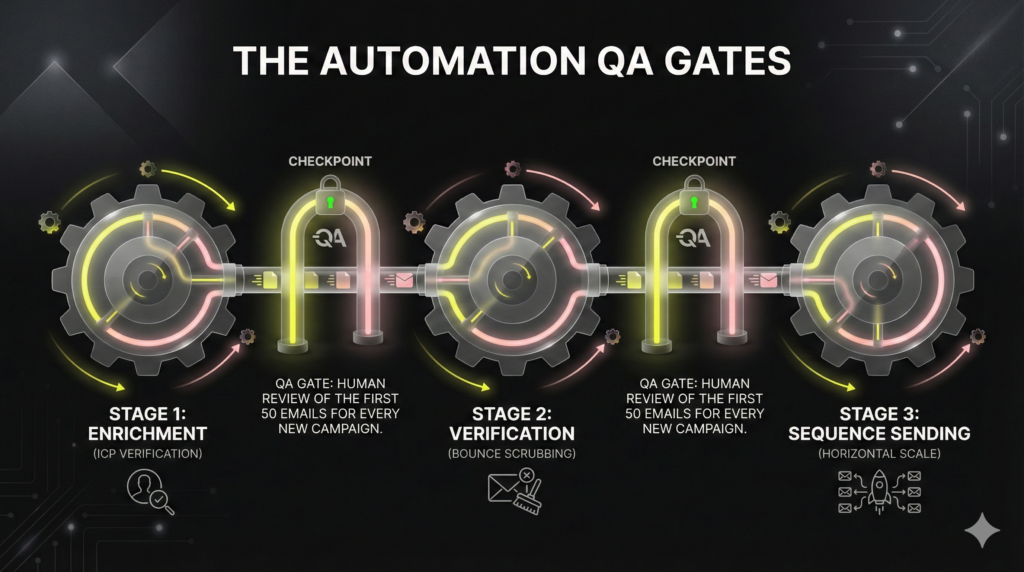
Automating the cold outreach for MSP pipeline requires installing quality assurance (QA) gates to ensure scale reinforces, not compromises, quality.
Build a sequential machine covering five key stages:
- Prospecting/Enrichment: Finding and augmenting target data (e.g., Apollo or Clay categories).
- Verification: Scrubbing list health and validity (e.g., Kickbox or NeverBounce category).
- Sequence Sending: Deploying sequences via warmed domains (e.g., Instantly or Smartlead category).
- Reply Handling: Automated filtering for follow-up.
- CRM Handoff: Transferring clean, qualified prospects to a CRM (e.g., HubSpot or Pipedrive).
The critical guardrails ensure quality control: Block unverifiable emails immediately. Require a specific, human-verified personalization trigger for high-tier sends (Section 6). Crucially, mandate human review of the first 50 emails for every new campaign. Finally, prioritize fast, human responses for incoming replies; no bot should handle a qualified objection or question.
10. Convert Outreach to a Measurable Program: Scaling & KPIs
To transform cold outreach for MSP activity into a predictable pipeline and a scalable MSP business plan, avoid scaling based on vanity metrics (e.g., open rates). Establish strict measurement guardrails before increasing volume. Set realistic directional benchmarks (8 to 15% reply rate, 1 to 3% meeting-booked rate) that prioritize conversion and domain health.
| Primary KPIs | Secondary KPIs |
|---|---|
| Reply Rate, Meeting-Booked Rate | Positive Reply % |
| Bounce Rate, Spam Complaint % | Time-to-First-Reply |
A/B test the highest-leverage variables: the ICP segment and your low-friction offer, prioritizing offers over mere subject lines. Scale horizontally only after primary metrics stabilize for 2 to 3 weeks. Recycle lists quarterly using refreshed messaging to prevent prospect fatigue and reinforce domain reputation.
The 30-Day Operational Plan for Cold Outreach for MSP
Cold outreach is a critical, measurable operational process, not a passive marketing activity. Most MSP cold email fails when scaling volume prematurely, before achieving product-market fit in the inbox. Use this framework to translate prerequisites (ICP wedge, domain hygiene, low-friction offer) into a disciplined 12-week execution schedule for safe, repeatable growth.
Phase I: The 30-Day Pilot (Weeks 1 to 4)
Validate your core message and protect your sender reputation during this phase.
- Week 1: Build & Draft. Build 100 to 300 verified leads strictly matching your ICP wedge. Draft your core 3-step email sequence (Section 7).
- Week 2: Test & Monitor. Deploy the sequence at low volume (30 emails/day/inbox). Review every reply daily; refine messaging based on immediate pain points. Eliminate bounces and complaints (Section 10).
- Week 3: A/B Test. Introduce a single variable: test a new segment or a variant of your low-friction offer (Section 4). Use deep personalization cues (Section 6) for relevance.
- Week 4: Formalize SOP. Document the combination (segment + offer + template) that achieved the highest positive reply rate. Formalize this refined sequence as your Standard Operating Procedure (SOP).
Phase II: Disciplined Scaling (Months 2 to 3)
Manage scaling deliberately and horizontally to maintain deliverability.
- Expand Horizontally. Add inboxes and warm new sending domains (Section 3). Increase volume only after the 30-day SOP yields stable Key Performance Indicators (KPIs).
- Add Multi-Channel. Layer in light multi-channel touchpoints (LinkedIn profile view or connection request) only for prospects engaged with Email 1 or 2.
- Output Scorecard. Weekly, maintain a scorecard tracking Reply Rate, Meeting-Booked Rate, and Spam Complaint % (Section 10). Maintain a "Stop Doing" list, eliminating vague pitches and high-risk domain behaviors.