Your content gap analysis will fail if search bots cannot discover your site. To understand what is a technical audit for seo website, view it as the surgical removal of blockers to crawling, indexing, and rendering. While content audits address quality, technical health is the prerequisite for ranking. This guide delivers 9 audit areas and an ROI-driven workflow for developers and stakeholders. For an AI-native technical and GEO audit, NUOPTIMA can help.
Key Takeaways
- A technical SEO audit finds and removes the blockers stopping search engines from crawling, indexing, and rendering your site, which is the prerequisite for ranking.
- The audit covers nine areas: indexability, crawl management, site architecture, duplicate content, status codes and redirects, JavaScript rendering, Core Web Vitals, log file analysis, and AI visibility plus schema.
- Indexability is the binary gatekeeper: pages excluded from the index cannot generate organic revenue, so prioritize fixes on bottom-funnel landing pages first.
- Server log files prove what Googlebot actually does, turning a standard audit into a prioritized engineering roadmap for large or faceted sites.
- For AI search visibility, entity clarity and schema (Organization, Service, FAQ) make your brand extractable by the LLMs powering ChatGPT and Perplexity.
A technical SEO audit is the systematic process of finding and removing the technical blockers that stop search engines from crawling, indexing, and rendering a website, so existing content can rank.
1. Indexability: The Binary Gatekeeper
Publishing high-intent content is wasted effort if search engines are forbidden from seeing it. Indexability is the binary guardrail of any technical audit. Pages excluded from the index cannot generate organic revenue or pipeline.
Identify barriers preventing discovery:
- Accidental noindex directives in meta robots or X-Robots-Tag headers.
- Robots.txt files blocking high-value directories.
- Canonical tags pointing away from priority URLs.
- Soft-404 errors and duplicate clusters.
Diagnose patterns via Google Search Console Indexing reports. Use the URL Inspection tool to spot issues across specific templates or parameters. Prioritize fixes for bottom-funnel (BOFU) landing pages to capture immediate ROI. Resolving these blocks unlocks rankings for existing assets, preventing investment in content Google cannot surface.
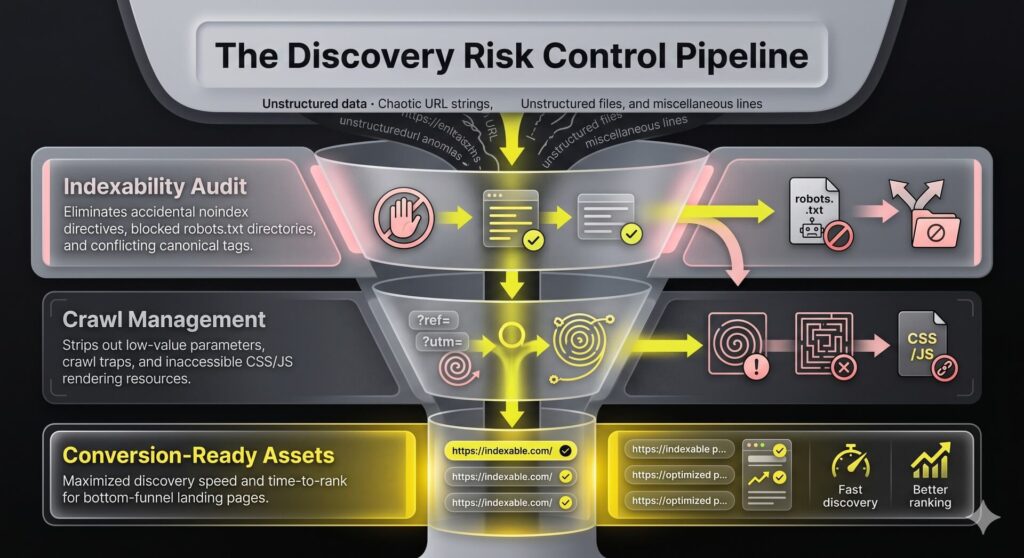
2. Crawl Management: Risk Control for Resource Efficiency
Crawl management is technical risk control. High-quality content fails to rank when bots waste crawl budget on low-value parameters or inefficient architecture, emphasizing the need for strict crawl budget optimization. A technical audit ensures search engines prioritize conversion-ready pages instead of getting stuck in crawl traps often created during migrations or template changes.
Review robots.txt rules, meta robots, and X-Robots-Tag headers for accidental blocks. Verify that CSS and JS files required for rendering are accessible. If bots cannot crawl these resources, your content remains invisible to both Google and AI discovery engines.
Diagnose leaks by crawling with a spider to identify blocked URLs. Cross-reference findings with GSC Crawl Stats and the URL Inspection tool. Streamlining access improves discovery speed and time-to-rank while preventing engineering teams from wasting cycles on content problems that are actually technical crawl restrictions.
3. Site Architecture: The Multiplier for Organic Authority
High-intent pages often languish on page five due to siloed architecture. This bottleneck prevents authority from reaching conversion-ready URLs. Internal linking acts as the strategic multiplier, distributing equity site-wideas part of your site architecture SEO framework.
Audit for technical blockers that impede discovery:
- Crawl depth exceeding four clicks.
- Internal links pointing to non-canonical URLs.
- Inconsistent navigation paths.
- Orphan pages invisible to bots.
Diagnose these gaps by exporting an internal link graph segmented by template (blog, category, product, and documentation). Cross-reference Google Search Console landing pages against crawl data to identify URLs the crawler cannot reach. Orphaned pages cannot compete when they remain structurally invisible.
Architecture optimization provides the fastest performance lift without new content. Repairing link structures ensures authority is distributed to existing pages, enabling them to capture organic pipelines.
4. Duplicate Content: Solving System Design Flaws
Treating duplicate URLs as isolated errors is a losing battle. On enterprise sites, duplication is a system design flaw. Inconsistent trailing slashes, tracking parameters, and faceted navigation create near-infinite crawl spaces. This bloat bleeds authority from revenue-driving assets.
Diagnose leaks by crawling for canonical chains. Use the Google Search Console (GSC) Indexing report to find where Google ignores your declared canonicals. If tags are dismissed, your architecture is sending conflicting signals to search bots and AI discovery engines.
Consolidating signals into primary URLs improves rank stability and prevents Google from swapping high-value pages for low-value variants. Proper parameter handling ensures your technical infrastructure supports sustainable organic revenue. This eliminates duplicate-page bloat that dilutes authority and makes performance reporting unreliable.
5. Status Codes and Redirects: Eliminating Friction on Conversion Paths
Broken paths are literal dead ends for customers and search bots. Technical friction on high-intent landing pages directly causes lead abandonment and visibility loss. Identify these critical issues during your technical audit for an SEO website:
- 4xx and 5xx response code spikes.
- Redirect chains and infinite loops.
- Mixed 200/3xx canonical behavior.
- Broken internal links on key conversion paths.
Diagnose leaks by crawling for response codes and mapping redirect chains. Use server logs to validate intermittent 5xx errors that standard spiders often miss.
Resolving these friction points improves crawl efficiency and prevents abandonment on high-value pages. This protects your organic-to-lead conversion. We do not optimize for health scores. We optimize for revenue.
6. JavaScript Rendering: Eliminating Invisible Content Risk
JavaScript rendering is a critical technical gap where competitors lose visibility. If your headless CMS architecture relies on Client-Side Rendering (CSR), search bots often encounter an empty shell during the initial crawl.
Verify these elements appear in the raw HTML:
- Primary body content
- Internal linking structures
- SEO tags (canonicals, titles, and meta descriptions)
Diagnose gaps by comparing raw source code against the rendered DOM. Use GSC's URL Inspection "Test Live" tool to check rendered HTML and screenshots across representative templates.
Implementing Server-Side Rendering (SSR) or Static Site Generation (SSG) reduces indexing delays and invisible content risk. This technical shift protects high-value service pages where ranking directly drives your organic revenue pipeline.
7. Core Web Vitals: Performance as a Conversion Multiplier
High performance is a UX efficiency requirement, not a vanity metric. Sluggish mobile speeds on high-intent pages trigger immediate lead abandonment before your value proposition renders. Faster load times protect organic revenue by reducing bounce rates on critical entry points.
When conducting a what is a technical audit for seo website, prioritize template-level performance bottlenecks:
- Heavy images and uncompressed fonts
- Excessive JavaScript and third-party scripts
- Slow server responses and poor mobile rendering
Diagnose by pulling field data from high-traffic money pages to identify real-world friction. Use lab tools to pinpoint render-blocking fonts or scripts that cripple mobile experience. Target remediation for pages that already convert to maximize lead lift. Treat performance as a strategic investment in conversion-ready traffic rather than a general site-wide refactor.
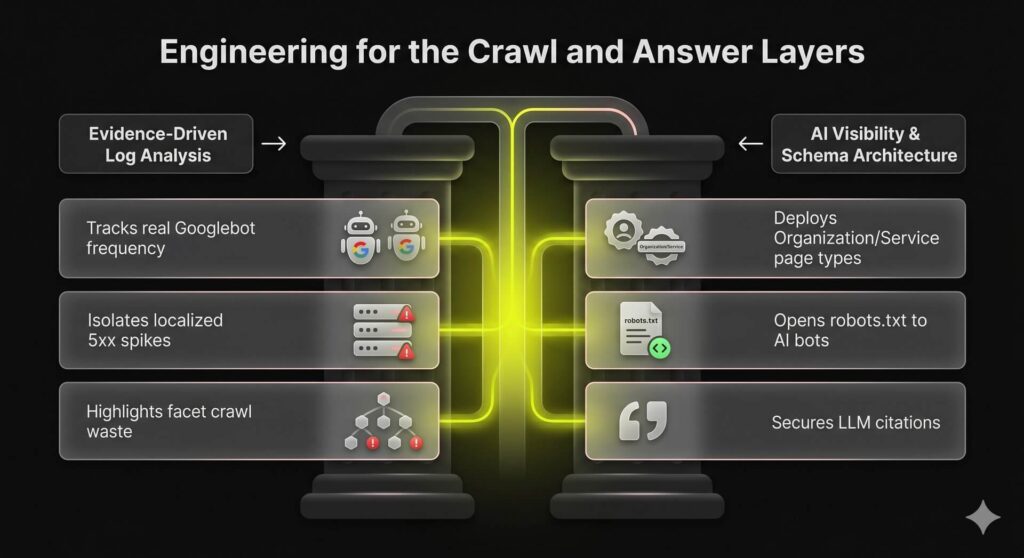
8. Log File Analysis: Turning Audits into Engineering Roadmaps
Standard SEO tools simulate what crawlers see, but server logs prove what Googlebot actually does. This evidence layer transforms a standard technical audit into a prioritized engineering roadmap for large-scale sites and complex faceted navigation.
- Crawl frequency on priority templates versus low-value parameters.
- Crawl waste on facets, session IDs, and filters.
- Localized spikes in 5xx errors during bot activity.
Analyze logs by user-agent and URL patterns to identify where Google ignores high-value pages while hitting low-value URLs. Comparing logs against crawl exports reveals the gap between indexation intent and actual crawler behavior. Log-driven fixes prevent wasted development cycles by focusing resources on architecture changes that measurably improve crawl allocation toward pages driving your organic revenue and pipeline.
9. AI Visibility and Schema: Engineering for the Answer Layer
Standard technical audits often ignore why healthy sites fail to appear in ChatGPT or Perplexity. The gap is entity clarity. A modern technical audit for seo website ensures your brand is extractable by the Large Language Models (LLMs) powering the answer layer.
Audit baseline schema coverage for:
- Organization and Service page types
- Relevant FAQ sections
- Consistent entity signals (brand name, addresses, and authorship)
Validate structured data output and ensure AI crawlers have full access in robots.txt. Content trapped behind heavy scripts or restrictive rules prevents engines from citing your expertise. This engineering increases rich result eligibility and secures LLM citations, building a visibility moat that compounds as search behavior evolves. Fixing these gaps ensures foundations support both rankings and generative citations.
How to Build a Technical Audit Execution System
Transform your audit from a static report into a revenue-generating roadmap. Use this five-step framework to convert raw evidence into a prioritized backlog.
Step 1: Build an Evidence-Based Dataset
Export crawl data including status codes, canonicals, and crawl depth. Pull GSC exports for indexing trends, sitemaps, and Core Web Vitals. Include server logs for enterprise sites. You will establish a dataset built on technical evidence rather than subjective opinions.
Step 2: Create a Developer-Ready Backlog
Convert findings into functional tickets. For each issue, document affected templates, reproduction steps, expected behavior, and the recommended fix. Define the validation process for post-release. This creates a task list that reduces friction during the engineering sprint.
Step 3: Prioritize Using PIE Scoring
Score every task based on Potential, Importance, and Ease (PIE) or an Impact vs. Effort quadrant. Define these scores in plain language to gain stakeholder consensus. You will see a ranked roadmap that aligns technical needs with commercial reality.
Step 4: Map Fixes to Business Impact
This step shows stakeholders what is a technical audit for seo website by linking repairs to revenue outcomes. Document how an indexability fix unlocks specific bottom-funnel pages or protects high-margin templates. This transforms technical debt into a strategic ROI narrative.
Step 5: Validate and Close the Loop
Re-crawl the site 2 to 4 weeks after deployment to verify results. Monitor GSC crawl stats and indexing reports to confirm success. Track leading indicators such as crawl frequency and template-level CWV scores to ensure stability as you scale.
Schedule your strategy call with NUOPTIMA for an AI-native technical and GEO audit to dominate both Google rankings and the answer layer.
Visit nuoptima.com or explore our GEO services to learn how we can help your brand dominate the evolving search landscape.