Marketing teams often fall into a traffic trap where content ranks but fails to move buyers. An effective seo strategy funnel functions as a revenue system, bridging traditional search with Generative Engine Optimization (GEO). When properly architected, this structure transforms your website into a managed IT services marketing growth engine that scales predictably.
This map aligns TOFU, MOFU, and BOFU assets with buyer intent and LLM citations while integrating internal linking and KPIs. Don’t just rank. Be the answer. Structure your funnel stages correctly to build assets that match intent.
Key Takeaways
- An SEO strategy funnel maps TOFU, MOFU, and BOFU content to buyer intent so the site drives pipeline, not just traffic.
- TOFU targets informational intent (what is, how to), MOFU targets comparison intent (best, vs, alternatives), and BOFU targets conversion intent (pricing, demo, services).
- Sanity-check intent against the live SERP: if product pages dominate, treat the keyword as BOFU; if guides dominate, deploy TOFU or MOFU.
- Internal links are the funnel mechanics: every TOFU page should carry one MOFU link, one BOFU link, and one sideways link to force pipeline velocity.
- Replace total-traffic vanity metrics with stage-specific KPIs and add a GEO layer that tracks brand citations in ChatGPT and Perplexity.
An SEO strategy funnel is a content architecture that aligns top, middle, and bottom-funnel assets with buyer intent and AI citations so organic search produces predictable pipeline rather than unconverted traffic.
1. Map Funnel Stages to Operational Search Intent
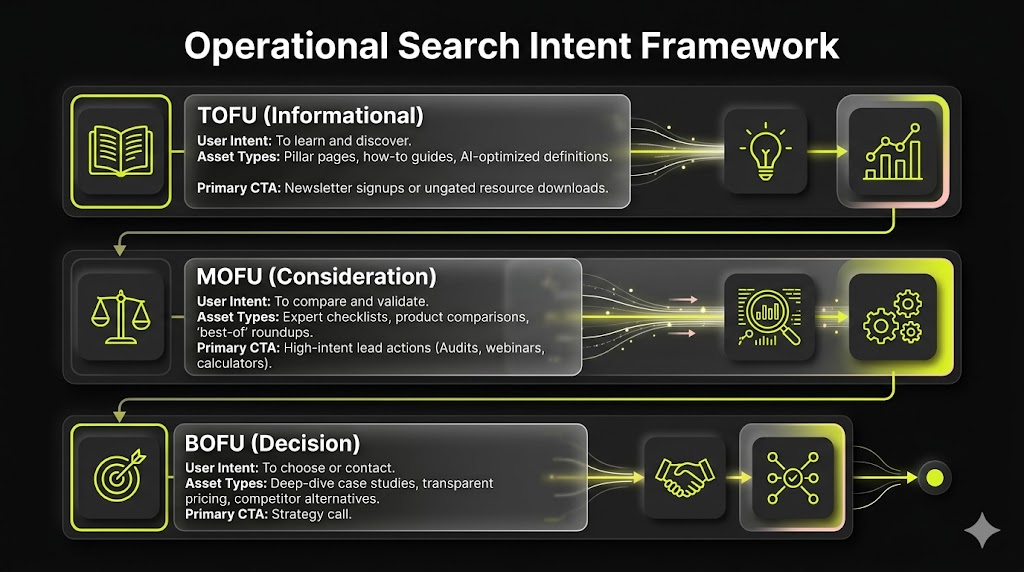
Most marketing funnels are theoretical fluff. To drive organic revenue, your SEO strategy funnel must move from marketing theory to operational filters. This framework serves as the decision filter for keyword mapping and page architecture:
- TOFU (Informational): Intent is to learn. Deploy pillar pages, how-to guides, and AI-optimized definitions. The CTA should drive newsletter signups or ungated resource downloads. Measure success through traffic volume and brand impressions.
- MOFU (Consideration): Intent is to compare and validate. Use expert checklists, product comparisons, and "best-of" roundups. Pivot the CTA toward high-intent lead actions like audits, webinars, or calculators. Track lead conversion rates and pipeline velocity.
- BOFU (Decision): Intent is to choose or contact. Consolidate trust with deep-dive case studies, transparent pricing, and competitor alternatives. The only logical CTA is a strategy call. Measure strictly by revenue and pipeline contribution.
This operational clarity prevents mismatched content. It ensures you never push demos on informational pages and gives your team a shared definition for every organic asset. This operational alignment is especially crucial when structuring a local SEO for IT company to win distinct regional territories.
2. Match Keywords to Format with Intent Modifiers
Traditional keyword research provides volume data but lacks a structural blueprint. Guessing between an informational guide and a transactional landing page causes intent mismatch. This is where organic revenue dies.
Use intent modifiers as operational filters to align your seo strategy funnel. These terms define user expectations and dictate the required SERP format for both Google and generative engines.
| Funnel Stage | Key Modifiers | Content & SERP Implication |
| TOFU | what is, how to, why, examples, signs of | Informational. Optimized for AI Overviews and featured snippets. |
| MOFU | best, vs, alternatives, reviews, guide | Comparison. Optimized for listicles and expert review citations. |
| BOFU | pricing, cost, demo, trial, agency, services | Conversion. Optimized for direct product or landing pages. |
Sanity-check intent via the live SERP before execution. If product pages dominate the first page, classify the keyword as BOFU. If guides prevail, deploy TOFU or MOFU assets. Mirroring the dominant format ensures your content is prioritized for both traditional rankings and LLM citations.
3. Engineer TOFU Assets for Depth and AI Citations
Shallow TOFU content is a liability. Guides that merely mirror LLM summaries lose the click to an AI Overview. To drive revenue, your seo strategy funnel requires assets engineered for both human depth and machine extraction.
Ship content with high information gain. Use a clear question as the H1 and deliver a definitive answer in the first paragraph. Follow with scannable headings, data tables, and a structured FAQ block to ensure LLMs prioritize your brand for citations.
Every TOFU piece must serve as a bridge to consideration. Generic "related posts" sidebars fail the revenue test. Instead, embed two or three contextual internal links to MOFU assets such as:
- "Best-of" roundups
- "Alternative" guides
- Competitor "vs" comparisons
This structure turns awareness into action. It forces readers deeper into the funnel while keeping informational content valuable in zero-click environments.
4. Prioritize MOFU Assets for Evaluation and Shortlisting
High organic volume fails when the middle of the funnel is hollow. Most teams over-invest in awareness but ignore the evaluative stage where buyers shortlist vendors. To fix your seo strategy funnel, build assets that mirror how B2B leaders find answers across Google and generative search surfaces.
MOFU Assets to Prioritize
Prioritize these formats to address buyer risk and influence selection:
- "Best [Category]" Lists: Influence LLM recommendations by appearing as a top-tier peer.
- "Alternatives" Pages: Capture high-intent traffic from users looking to switch providers.
- Outcome-Driven Case Studies: Use quantifiable data to trigger AI citations and mitigate risk.
Converting Demand into Pipeline
Convert without friction by avoiding premature demo requests. Use "soft" CTAs that provide immediate value and establish entity authority:
- GEO readiness audits
- SEO strategy templates
- Demo-lite recordings
These assets qualify prospects and route high-intent users to BOFU pages once they are sales-ready. This strategy turns passive research into a predictable pipeline.
5. Optimize BOFU Pages for Ranking and Revenue
Most BOFU pages fail by treating search visibility and conversion as opposing goals. Pure conversion pages often lack the technical depth required for Google rankings and LLM citations. To optimize your seo strategy funnel, BOFU pages must act as both sales closers and authoritative entities that provide clear, structured data to capture commercial intent.
Construct your BOFU pages using this high-density blueprint:
- Above-the-fold intent matching that mirrors the specific buyer query.
- Quantified proof blocks (case studies and testimonials) to verify brand authority for generative engines.
- Objection-handling FAQ sections to capture long-tail transactional queries and provide extractable answers for AI.
- A single primary conversion action to prevent decision fatigue and maximize lead quality.
Convert high-intent organic traffic into revenue by booking a strategy call with NUOPTIMA. For brands requiring dominance in AI-generated answers, utilize our Generative Engine Optimization (GEO) services to secure your next-generation search visibility and LLM citation growth.
6. Force Pipeline Velocity with Intent-Based Internal Linking
Internal links are the funnel mechanics. Without them, you have a blog, not a funnel. To drive organic revenue within your seo strategy funnel, you must implement strict linking rules that mirror buyer intent.
Establish a default path that pushes users down the funnel. TOFU assets must link to MOFU comparisons, while MOFU assets link directly to BOFU solution pages. BOFU content should avoid linking back to broad TOFU guides unless it resolves a direct sales objection.
This structure moves users toward conversion intentionally rather than relying on navigation randomness. Every TOFU page requires three bridge links to ensure intentional movement:
- 1 MOFU link: A comparison guide to help users evaluate solutions.
- 1 BOFU link: A direct path to your service or solution page.
- 1 sideways link: Content within the same stage to reinforce entity authority.
This architecture ensures every organic visit contributes to the pipeline.
7. Replace Vanity Reporting with Stage-Specific KPIs
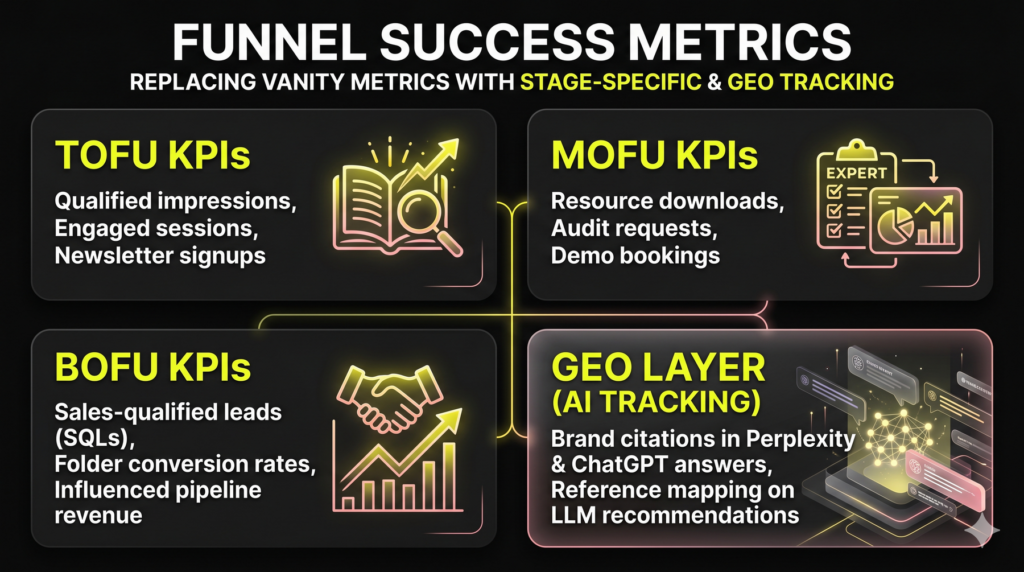
Total traffic is a vanity metric that masks funnel leakage. Effective seo strategy funnel management requires specific success definitions for each stage. Do not apply universal metrics; instead, align KPIs with the reader’s intent.
- TOFU: Qualified impressions, engaged sessions, and newsletter signups.
- MOFU: Resource downloads, audit requests, and demo bookings.
- BOFU: Sales-qualified leads (SQLs), conversion rates, and influenced revenue.
Search is bifurcating. You must add a Generative Engine Optimization (GEO) layer to your reporting because traditional TOFU clicks often degrade while visibility rises. Track brand mentions and citations within AI answers in Perplexity and ChatGPT. Verify if your BOFU pages serve as primary sources for LLM-generated recommendations.
Visibility without a click remains a competitive advantage. Dominating the answer layer ensures your brand is the trusted source throughout the buyer's research process. Measurement must adapt to this AI-driven reality to prove ROI and protect market share. This dual-layer reporting proves that organic investment translates directly to pipeline.
How to Build Your SEO Strategy Funnel: A 30-Day Execution Roadmap
Most marketing guides list items to build but fail to provide a repeatable workflow for implementation. This roadmap transforms your seo strategy funnel from a theoretical concept into a weekly marketing cadence. Follow these steps to move from generic content lists to a structured revenue machine engineered for both Google and generative search engines.
Step 1: Inventory and Tag Every Page by Funnel Stage
Export all URLs from your CMS and sitemap into a central audit document. You must categorize every live page by its functional role: TOFU, MOFU, or BOFU. Assign a stage to every URL based on user intent and search volume. Tag the specific conversion purpose for each page, such as a newsletter subscription, resource download, or demo request. This inventory identifies exactly where your content funnel is hollow and which stages require immediate investment to support your pipeline.
Step 2: Build a Stage-Based Keyword Map
Create a single master spreadsheet to manage your funnel architecture. Organize the document into three distinct tabs for TOFU, MOFU, and BOFU targets. This separation prevents intent overlap and ensures your team understands the specific commercial goal of every keyword. Include columns for target keyword, modifier, intent type, target URL format, primary CTA, owner, and the scheduled publish or refresh date. This centralized map serves as the primary deliverable for your quarterly production schedule. Incorporating parameters from a specialized SEO for IT company guide will ensure technical taxonomy matches exact pipeline objectives.
Step 3: Define the Asset Mix for the Next 30 to 60 Days
Apply the Feeder Rule to ensure your content ecosystem is inter-connected. High-intent BOFU pages cannot drive sustainable revenue if they lack internal authority. For every BOFU landing page, assign at least two MOFU feeders like product comparisons or expert reviews. For every MOFU asset, assign at least two TOFU feeders like educational guides or industry definitions. This structure ensures that every piece of informational content bridges the gap toward a commercial transaction.
Step 4: Add Internal Link Paths Before Publishing
Never publish a new page without a defined exit path for the reader. You must pre-plan how a user moves from an informational guide toward a transaction. Identify three bridge links for every new page before it goes live. Optimize anchor text to align with the next-stage intent. Replace generic "click here" text with descriptive, action-oriented phrases like "view case studies" or "compare pricing." This linking strategy forces pipeline velocity by guiding users through the funnel stages.
Step 5: Implement Pipeline-First Reporting
Shift your reporting away from vanity metrics like total traffic and focus on business outcomes and Generative Engine Optimization (GEO). Report results by funnel stage to leadership. Show what was shipped, which pages moved in rankings, and which assets directly influenced the pipeline. Include a GEO callout to track brand citations in AI-generated answers. Use LLM citation analysis to monitor where your brand is cited as the definitive answer in ChatGPT and Perplexity environments.
If you want this funnel engineered for Google and AI search, start at Nuoptima or review NUOPTIMA’s GEO service .