Most SEO reporting MSP frameworks fail because they prioritize ranking screenshots over qualified conversations. When reports highlight vanity metrics while MRR remains stagnant, stakeholders lose trust. We solve this by tying organic visibility directly to pipeline impact and measurable outcomes. This system transforms technical data into a revenue narrative built for the scrutiny of PE partners and CEOs. To start, we must fix instrumentation to ensure every metric remains trustworthy.
Key Takeaways
- SEO reporting for MSPs should tie organic visibility to pipeline impact and recurring revenue, not ranking screenshots or vanity traffic that erodes stakeholder trust.
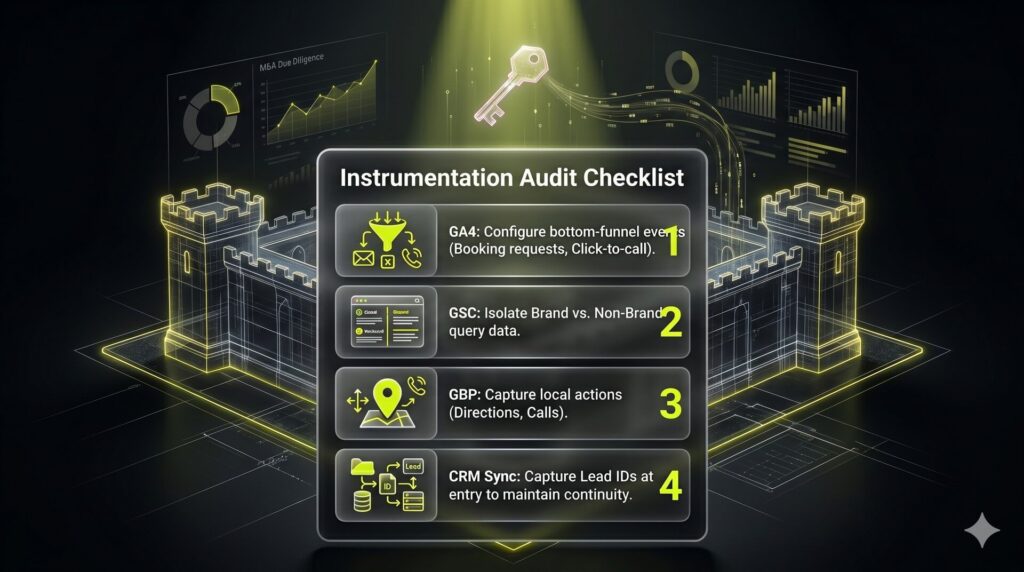
- Fix instrumentation first: configure GA4 bottom-funnel events, isolate brand versus non-brand queries in Search Console, and connect Google Business Profile to capture local calls and directions.
- Standardize a KPI dictionary defining Lead, MQL, and SQL so marketing and sales share one language and reports reflect lead quality rather than raw volume.
- Capture offline interactions like click-to-call and booking confirmations, because the MSP buying motion starts with a phone call that otherwise makes ROI look artificially low.
- Use two attribution windows: a 30 to 90 day window for demand and lead volume, and a rolling 6 to 12 month window for pipeline created and closed-won revenue.
SEO reporting for MSPs is a measurement framework that connects organic search data to qualified pipeline and recurring revenue, translating rankings and traffic into outcomes that withstand investor-grade scrutiny.
1. Prioritize Measurement Integrity Over Vanity Dashboards
Empty sales calendars paired with record traffic reports erode founder trust. Before designing dashboards, establish baseline instrumentation to prevent presenting misleading data during M&A due diligence. This ensures measurement integrity for investor-grade scrutiny.
Audit your technical foundation to ensure specific data capture:
- GA4: Configure bottom-funnel events including booking requests, forms, and click-to-call.
- Google Search Console: Verify access to isolate brand versus non-brand query data.
- Google Business Profile: Connect the profile to capture local actions like calls and directions.
Your SEO reporting MSP framework must segment organic landing pages and local conversions as distinct line items from day one. Include a tracking health note to document any configuration changes. This rigorous approach moves reports from technical noise toward actionable revenue outcomes.
2. Standardize Your KPI Dictionary to Eliminate Reporting Friction
Disconnected reporting occurs when conversions mask poor lead quality. If marketing claims fifty leads but the pipeline remains dry, you lack a shared language. To resolve this, build a KPI dictionary that translates technical SEO into recurring revenue outcomes.
Define your funnel stages strictly:
- Lead: Any raw entry, including calls, forms, or chats.
- Marketing Qualified Lead (MQL): Matches ICP signals like employee size and industry or meets minimum data completeness.
- Sales Qualified Lead (SQL): Accepted by sales with a clear compliance driver, budget fit, and high buying-intent.
Standardize your SEO reporting MSP outputs across two cadences:
- Weekly: Monitor lead volume and quality trends to identify immediate performance shifts.
- Monthly: Analyze the MQL to SQL conversion rate and identify the specific landing pages generating SQLs.
This framework ensures reports reflect enterprise valuation and pipeline growth rather than vanity traffic.
3. Capture Offline Interactions to Prove True SEO ROI
The MSP buying motion typically begins with a phone call or consultation request. If these offline interactions are not tracked, your SEO reporting MSP ROI looks artificially low. This data gap devalues your organic equity during M&A due diligence, where every marketing dollar must link to enterprise growth.
Capture organic demand by instrumenting specific high-intent events:
- Mobile click-to-call triggers.
- Contact form submissions.
- Booking calendar confirmations.
Separate support intent from sales intent immediately. Counting helpdesk tickets as conversions pollutes your data and inflates cost-per-lead metrics.
Attribute these actions to specific landing pages to identify which service lines drive the most profitable conversations. Include a quality note field to track the percentage of spam and wrong-fit industries. Highlighting lead quality builds the transparency needed to justify higher valuations and prepare for high-stakes scaling.
4. Deploy a Lightweight MVP Dashboard for High-Stakes Transparency
Fragmented reporting often buries critical revenue insights under irrelevant technical data, undermining stakeholder confidence. To bridge this technical authority gap, build a lightweight MVP dashboard using GSC for demand, GA4 for engagement, and a lead truth table for outcomes.
Your Executive Summary should focus on three high-value metrics:
- Local Visibility: GSC impressions and clicks.
- Qualified Leads: CRM-verified conversions.
- Pipeline Influenced: Total contract value linked to search.
Isolate non-brand queries in GSC to prove you are capturing new market intent rather than just existing referrals. If CRM data is messy, use a Google Sheet as a lead truth table to maintain an investor-ready ledger of SQLs. Schedule a monthly PDF export for leadership while providing a live dashboard link for self-service. This ensures your SEO reporting MSP strategy aligns directly with EBITDA growth.
What to Put in an MSP SEO Report
A useful MSP SEO report answers one question: is search producing qualified pipeline, and which pages are doing the work. Everything below the executive summary exists to support that answer, not to fill pages. Group your report into four sections and cut anything that does not map to a lead or a ranking that leads to one.
- Keyword rankings that matter: Track position for the commercial terms a buyer types before they switch, not every keyword you rank for. Prioritize your MSP keyword research shortlist of service and switcher queries, and report movement on those alone.
- Traffic by source: Split organic, direct, referral, and paid so leadership sees which channels compound. Organic to your core service pages is the line that signals durable equity; brand-direct traffic flatters the picture and should be labeled separately.
- Local visibility: Report Google Business Profile impressions, calls, and direction requests alongside local pack position. Tie these back to your local SEO for MSPs work so a call spike has a cause, not just a number.
- AI and citation presence: As buyers ask Perplexity and ChatGPT for a shortlist, log whether your firm is named. Pair this with your MSP SEO AI citation strategy so the report shows citation share, not just blue-link rankings.
Keep each section to the few lines that change a decision. A report a CFO can read in two minutes and act on beats a forty-tab dashboard nobody opens.
5. Visualize Local Share of Voice to Prove Market Dominance
For MSPs competing in local corridors, average rank is a weak narrative that ignores proximity to high-value prospects. Transition your SEO reporting MSP framework toward visual local Share of Voice (SOV) using geographic ranking heatmaps. These grids track GBP performance across specific neighborhoods, turning abstract data into a competitive scoreboard. When a rival dominates the map in a target financial district, the strategic gap is immediately obvious to leadership.
How to Report Visibility
Report progress with a single before vs. after grid snapshot each month. Annotate the image with the actions driving the shift:
- GBP profile optimizations and citation cleanup
- Localized service page updates
- Review generation campaigns
This visual evidence proves you are capturing physical territory, making SEO momentum undeniable for technical founders and non-marketers.
6. Build Attribution That Survives Investor-Grade Scrutiny
Most MSPs cancel SEO programs just as ROI peaks because they measure enterprise contract cycles like commodity purchases. To survive investor-grade scrutiny, you must build an attribution model that connects initial search queries directly to signed contracts.
Capture lead IDs at entry and sync them to your CRM immediately. Ensure records store the first-touch source, landing page, and conversion date. This maintains lead ID continuity from the initial form or call to the final CRM record, providing the data needed for investor due diligence.
For effective SEO reporting MSP, use two distinct reporting windows:
- Short Window (30 to 90 Days): Monitor demand signals and raw lead volume.
- Long Window (Rolling 6 to 12 Months): Track pipeline created and closed-won revenue influenced by organic first-touches.
Always include deal receipts. These are specific opportunities tied to high-intent pages that prove your SEO builds organic equity, not just rented traffic.

Monthly Execution Schedule: 75 Minutes to Revenue Clarity
Transform your SEO reporting MSP framework into a high-speed operating cadence. This schedule ensures technical data translates into a revenue narrative that stands up to investor scrutiny and builds organic equity.
1. Data Hygiene and Connectivity Check (10 Minutes)
Verify GA4 and Search Console (GSC) data flow to protect measurement integrity. Confirm Google Business Profile captures local actions. Document site releases or tracking anomalies that skew monthly figures.
Outcome: You establish a validated data baseline.
2. Audit Visibility and Market Demand (15 Minutes)
Analyze non-brand query movement in GSC to prove you are capturing new market intent. Monitor click and impression trends for your top five priority landing pages to identify where technical authority is expanding.
Outcome: You gain a clear view of share of voice and top-funnel demand.
3. Quantify Funnel Outcomes (20 Minutes)
Categorize raw leads into MQLs and SQLs using your specific KPI dictionary. Map the breakdown of calls versus web forms to identify the highest-converting contact methods for IT decision-makers.
Outcome: You generate a ranked list of pages producing actual SQLs.
4. Pipeline Reconciliation and Attribution (20 Minutes)
Sync organic-sourced leads with CRM records to calculate pipeline value. Review stage distribution and time-to-SQL for all search-originated deals to demonstrate M&A readiness.
Outcome: You produce a ledger of organic equity linked to contract value.
5. Draft the Executive Narrative (10 Minutes)
Summarize the month with three specific wins, three market risks, and three upcoming actions. Focus the narrative on EBITDA impact and exit readiness rather than simple traffic volume.
Outcome: You provide a concise briefing ready for stakeholder review.