Personalized SERPs and AI answers are compressing organic clicks, ending the era where single pages win reliably. To dominate 2026, brands require dense topical infrastructure that secures both traditional rankings and measurable AI citations.
NUOPTIMA provides a 7-step system to build an seo content cluster engineered for Google and generative engines. Leverage our AI-native expertise at nuoptima.com and our GEO services at https://nuoptima.com/generative-engine-optimization-geo-services to dominate the answer layer. We start by scoping clusters around specific money-page outcomes.
Key Takeaways
- An SEO content cluster is dense topical infrastructure (one pillar plus supporting spoke pages) engineered to win both traditional rankings and AI citations.
- Every pillar should map to one core promise and one primary entity, with three to five sub-intents and a defined conversion action like a demo or signup.
- Map keywords into four query classes: definition, comparison, use-case, and proof/ROI, assigning one target page per query to prevent cannibalization.
- Use a strict hub-and-spoke linking model where pillars link to every spoke and each spoke links back with descriptive, entity-rich anchor text.
- Clusters rarely convert on last click, so measure them with multi-surface attribution: assisted conversions, internal link CTR, and AI citation frequency.
An SEO content cluster is a group of interlinked pages, built around a central pillar and supporting spoke pages, designed to signal topical authority to search engines and serve as a citation source for generative engines.
1. Align Your Pillar Strategy with Revenue Outcomes
Marketing teams waste months crafting broad "ultimate guides" that generate vanity traffic without a pipeline. Broad topics lacking commercial endpoints leave readers with nowhere to go and AI engines with no entity to cite. Enforce revenue discipline on every seo content cluster to prevent content churn. This anchors your effort to measurable business outcomes rather than abstract visibility.
Every pillar must serve a defined strategic role. Revenue-support pillars power service or use-case pages. Authority pillars define categories you intend to own. Adhere to the tight scope rule: one pillar represents one core promise and one primary entity. This ensures the cluster remains internally coherent and strategically focused.
Engineered for GEO, pillars must include extractable "best answer" blocks for LLM citation. Writers must define:
- A pillar keyword theme.
- Three to five sub-intents.
- A target conversion action such as a demo, signup, or shortlist.
Every cluster page must pass context and authority into the main pillar. View clusters as search infrastructure designed to funnel users toward a commercial endpoint. If a page fails to move a reader toward a revenue outcome, it does not belong in your strategy.
2. Map Keywords to Multi-Intent Query Classes
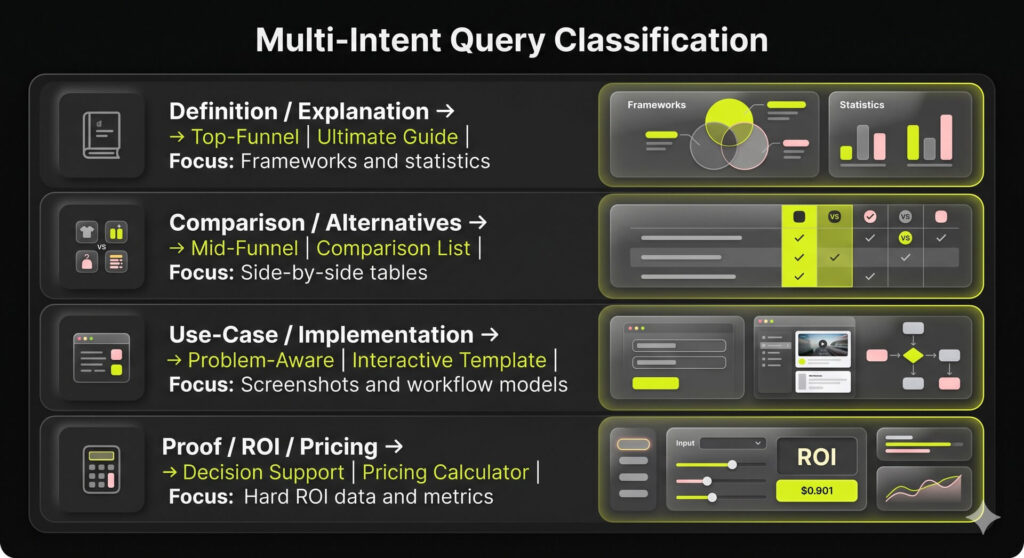
Static keyword lists fail because intent shifts across devices, contexts, and user history. A resilient seo content cluster requires categorizing your keyword universe into four query classes. This structure prevents internal competition and ensures you match the specific patterns search engines and LLMs prioritize.
- Definition / Explanation (Top-Funnel): Match guide patterns. Include proprietary frameworks and statistics to establish entity authority.
- Comparison / Alternatives (Mid-Funnel): Match listicle patterns. Provide side-by-side tables and specific examples for research-heavy users.
- Use-Case / Implementation (Problem-Aware): Match template or tool patterns. Use screenshots and workflow models to demonstrate practical execution.
- Proof / ROI / Pricing (Decision Support): Match calculator patterns. Use hard ROI data and case study metrics to support the purchase decision.
| Keyword Focus | Query Class | Page Type | Primary Pattern |
| Core Concept | Definition | Pillar | Ultimate Guide |
| Selection | Comparison | Cluster | Comparison List |
| Execution | Use-Case | Cluster | Interactive Template |
| Investment | ROI | Cluster | Pricing Calculator |
Keywords mapping to the same class and page type create cannibalization risks. Flag these intent collisions during the research phase to maintain a clean and authoritative search architecture.
3. Operationalize Semantic Clustering for Scalable Execution
Most organic strategies fail in the gap between raw data and site architecture. Do not settle for visual keyword maps that never reach production. Use LLMs for processing speed but apply human constraints to ensure every seo content cluster is actionable. Prompt the LLM with your keyword universe, audience parameters, and specific topic exclusions. Require a JSON output including:
- Cluster name and primary intent
- Target keywords
- Suggested H1 and URL slug
Speed without structure causes thin content and intent overlap, which underscores why basic automation SEO scripts require strict human guardrails. Validate machine outputs against these non-negotiable rules:
- One primary intent per cluster: Do not mix informational "definition" queries with transactional "comparison" queries on the same page.
- One target per query: Prevent internal cannibalization by assigning each query to a single best-fit page.
- Strategic internal linking: Each cluster page must serve a distinct purpose for passing authority back to the pillar.
To scale, use bulk-context batching to reduce classification costs while maintaining strict QC sampling. The final deliverable is a publishable cluster map, not a graphic. It lists page title, intent classification, draft URL, and owner. This workflow transforms keyword research into a revenue-driving search infrastructure roadmap.
4. Architect Pillar Pages as Authority Hubs and AI Sources
Most pillars fail by prioritizing length over strategic architecture. To dominate answer layers, your pillar must act as the "source of truth" that consolidates all sub-intents within your seo content cluster. This structure signals deep topical relationships to crawlers and establishes the canonical answer for AI engines.
Pillars require specific anatomy:
- Above-the-fold: A definitive entity definition, audience identifier, and "what you’ll learn" summary.
- Modular sections: Discrete content blocks mapped to specific sub-intents.
- Hub module: A scannable navigation block linking to every cluster page, placed prominently to route users and bots.
Use a strict hub-and-spoke internal linking model. Pillars link to every spoke, while each spoke links back to the pillar using descriptive, entity-rich anchor text. Cross-link between spokes only to clarify direct contextual relationships. To ensure GEO readability, include short, declarative statements that LLMs can extract as clean citations.
Deploy FAQ blocks with Schema markup to capture zero-click visibility.
Pillar Briefing Checklist:
- Entity definition in first 100 words.
- Modular sections aligned to sub-intents.
- Hub module with direct spoke links.
- FAQ block with Schema markup.
- Link target list: 10 to 15 internal spoke pages.
5. Standardize a Repeatable Internal-Linking Contract
Replace haphazard linking with a formal linking contract to guarantee architectural integrity. Every supporting page in your seo content cluster must adhere to these three requirements:
- Place one contextual link to the pillar page near the top where it makes semantic sense.
- Include 1 to 2 contextual links to relevant neighbor clusters to assist user navigation.
- Use descriptive anchor text that identifies the destination entity instead of generic phrases.
Select an execution model based on your operational scale:
- Manual: Insert links during the final editorial pass using a master cluster map.
- Semi-automated: Maintain a linking glossary that maps specific entities to target URLs for anchor consistency.
- Automated: Deploy workflows that match topic entities to existing URLs for inline insertion (requires manual QA).
Prioritize in-body links over low-value footer or blog-roll lists to maximize crawl priority and engagement. This protocol functions as a one-page SOP for writers to prevent inconsistent or forgotten connections. To bridge the strategy-production gap, add mandatory Internal Link Target fields to your content briefs. This ensures every asset functions as an interconnected system rather than an isolated page.

6. Resolve Internal Competition with Strategic Cluster Pruning
Redundant content actively sabotages rankings. Cannibalization occurs when multiple pages in your seo content cluster target the same query intent. This fragmentation splits internal link equity and confuses ranking signals, forcing search engines to choose between your assets rather than rewarding the topic's collective authority.
Maintain architectural hygiene by assigning strict page roles. The pillar is the broad, canonical source of truth. Cluster pages must address narrow, intent-specific queries. If pages overlap, consolidate via 301 redirect or differentiate intent.
Never use canonical tags as a substitute for disciplined planning. Prune your cluster when you identify persistent ranking overlap or index bloat that triggers crawl waste. Use this proven decision tree for your audit:
- Keep: Distinct intent with high assisted conversions.
- Merge: Similar intent with split rankings.
- Redirect: Outdated content that mirrors the pillar.
- Prune: Low traffic, zero conversions, and thin engagement.
Refresh the pillar first to reset the topical anchor. Then, update supporting cluster pages to ensure they feed the pillar with fresh, specific internal links. This operational rigor ensures your search infrastructure remains lean while topical authority and organic pipeline compound over time.
7. Prove Cluster Value with Multi-Surface Attribution
Standard attribution models fail most seo content cluster investments because clusters rarely convert on a last-click basis. They function as strategic infrastructure that assists high-intent money pages. To justify budget, you must replace vanity metrics with a multi-surface attribution model that tracks how informational content feeds the revenue funnel.
Deploy a cluster-level KPI stack to quantify this contribution. Track pillar and spoke rankings as distinct cohorts and measure internal link CTR to pillars. Monitor assisted conversions to identify sessions where cluster content preceded the final conversion. Measure the conversion rate lift on money pages after the supporting cluster is indexed.
Isolate performance by tagging pages by cluster in GA4 to generate cohort reports. Incorporate Generative Engine Optimization (GEO) metrics by tracking whether your assets serve as citation sources in AI answers. Use these insights to defend investment with clear attribution logic rather than speculative traffic volume.
Cluster Reporting Template:
- Keyword delta (Pillar vs. Cluster keywords)
- Organic landings by query class
- Internal link CTR (Cluster to Pillar)
- Assisted conversion volume
- AI citation frequency
Follow a continuous iteration loop: build, link, measure, and consolidate. This engineering approach ensures your clusters compound in value instead of wasting crawl budget.
Ready to engineer your search infrastructure for the next era of search? Partner with the AI native SEO experts at nuoptima.com or explore our https://nuoptima.com/generative-engine-optimization-geo-services to secure your authority in the answer layer.