Every MSP owner knows the friction: You are asset-rich, yet liquidity-poor because your business is the primary retirement vehicle. Retirement isn't a date; it is a strategic liquidity event. Success requires specific retirement planning for msp owners, aligning personal financial needs with M&A-grade readiness. This framework, built from guiding founders through eight-figure exits, outlines 8 moves to de-risk your operation and fund your future on your terms. Start with the one number that dictates everything: your financial target.
Key Takeaways
- Retirement planning for MSP owners starts with a freedom number: total future annual spending minus existing non-business investable assets equals the net proceeds your MSP must generate.
- Your true exit target is net proceeds after advisor fees, capital gains taxes, escrow holdbacks, and earn-outs, not the headline purchase price.
- Eliminating keyman dependency through SOPs, an empowered number two, and KPI dashboards directly raises the enterprise valuation multiple buyers will pay.
- Deal structure dictates the retirement timeline more than price: tie earn-outs to controllable metrics like MRR renewal rate, minimize escrow holdbacks, and start QSBS compliance years ahead.
- Recurring revenue transferability is the universal make-or-break factor, so audit client MSAs for assignment and change-of-control clauses before a Letter of Intent surfaces the risk.
Retirement planning for MSP owners is the process of aligning a founder's personal financial target with M&A-grade business readiness so the eventual sale or retained equity funds retirement on their own terms.
1. Calculate Your Freedom Number: Defining the Personal Exit Target
Technical founders often fixate on the headline purchase price. Real retirement planning for msp owners requires aligning that exit number with a guaranteed lifestyle, not maximizing the valuation multiplier.
Define the gap your MSP must fill. Quantify your total future annual spending (including healthcare and leisure), then subtract existing non-business investable assets. The remainder is the liquid capital target your MSP’s net proceeds must generate, via sale or sustained predictable cash flow from retained equity.
Your true exit target is always the net proceeds after advisor fees, capital gains taxes, escrow holdbacks, and earn-out structures. Creating a precise, single-page ‘Personal Balance Sheet + Target’ today defines the minimum required enterprise valuation, providing your Fractional CMO and CFO a quantifiable revenue goal.
A Worked Freedom-Number Example (Illustrative Only)
The freedom number stops being abstract the moment you run your own figures through it, so here is the arithmetic on placeholder inputs. These are illustrative numbers to show the method, not benchmarks or claims about what any MSP is worth. Swap in your real inputs and the logic holds.
Say your target retirement income is $200,000 a year. A common planning convention is to divide desired annual income by a conservative safe withdrawal rate to find the nest egg required. At an illustrative 4 percent, $200,000 divided by 0.04 implies a $5,000,000 liquid target. Now subtract what you already hold outside the business: if your personal investable assets are $1,500,000, the gap your MSP has to close is $3,500,000. That $3,500,000 is what your sale has to deliver as net proceeds, after advisor fees, capital gains taxes, escrow holdbacks, and any earn-out, not the headline price.
Work it backward and the target shapes the whole plan. If a buyer takes 20 percent as holdback and earn-out and your all-in advisory and tax drag is another slice, your headline enterprise value has to sit meaningfully above $3,500,000 to net that figure. The safe withdrawal rate, your tax outcome, and your holdback exposure are exactly the variables a transaction CPA should stress-test for you in 2026, because each one moves the required headline number. Run this once with honest inputs and you will know, before a single conversation with an acquirer like an Evergreen or Cork-style platform buyer, whether one exit funds your retirement or whether you need a longer runway.
2. Operationalize Delivery: Eliminate the Keyman Dependency
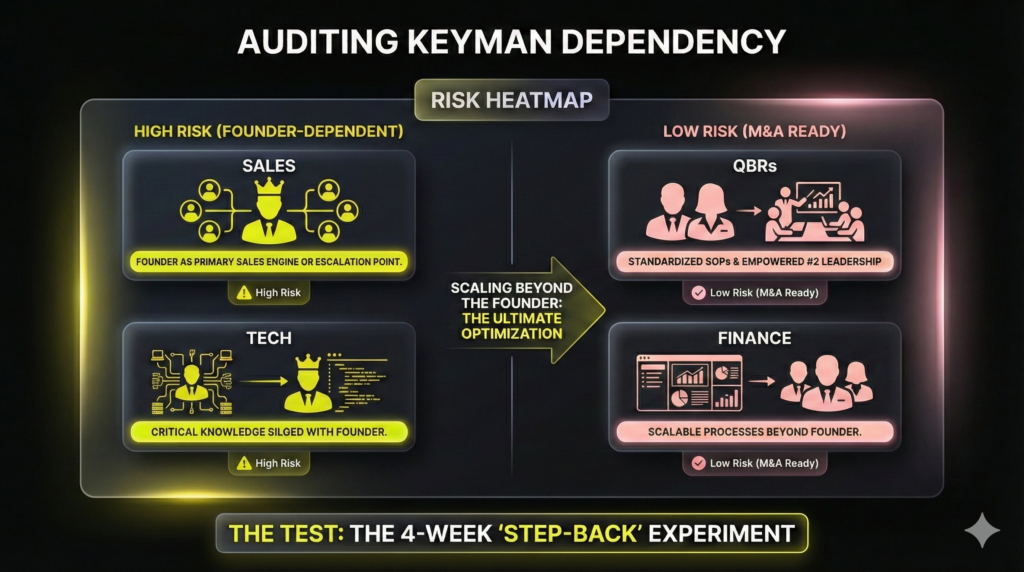
Achieving your exit target requires proving the business is transferable and repeatable. If you remain the primary sales engine, ultimate escalation point, or QBR owner, buyers will price that extreme Keyman Dependency risk directly into your enterprise valuation multiple. True retirement demands operational readiness.
Maximize your enterprise valuation by establishing these documented systems:
- Standardize SOPs: Create runbooks for high-friction areas: client onboarding, incident response, and the vCIO/QBR cadence. This proves consistency over tribal knowledge.
- Empower the #2: Promote a manager trained to own service delivery and critical client relationships. This is non-negotiable for a successful exit.
- Build KPI Visibility: Performance must not rely on intuition. Establish clear dashboards tracking margin, churn, MRR mix (managed services vs. projects), and ticket SLA adherence.
Test the system: Execute a two-to-four-week "step-back experiment." Take a true vacation, log everything that breaks, and systematically fix the operational gaps. This de-risks the asset and directly increases your M&A readiness. (148 words)
3. Valuation is a Diagnostic, Not a Vanity Metric: Focus on the Drivers
In M&A readiness, enterprise valuation is a diagnostic tool identifying risk and operational blind spots, not a final number. When engaging an advisor, demand more than a simple multiple. Request a defensible valuation range, complete with comparative analysis by size band and service mix.
The critical value drivers dictating this range must be your core focus:
- Percentage of recurring revenue (high MRR mix is premium).
- Client concentration (low concentration reduces risk).
- Quality of adjusted EBITDA margin.
- Consistency of growth and low client churn.
To show true adjusted earnings, your advisor must normalize owner compensation and remove one-time project spikes. The actionable result must be a "12-Month Value-Driver Plan," outlining the top three controllable levers and the monthly metrics (e.g., net MRR gain) required to increase your defensible valuation range. This is the difference between hoping for an exit and engineering one.
4. Diversify Your Exit Vehicle: Mitigating the Single-Asset Risk
You would never anchor 100% of your retirement planning for msp owners in a single, volatile tech stock. Yet, many founders treat their MSP, a singular asset, as the only guaranteed liquidity event. The risk is immense: a market downturn, a failed deal, or unexpected regulatory changes can instantly jeopardize your intended enterprise valuation.
Diversification is smart risk management and a core part of a sound exit strategy, not a lack of confidence in your company. Start building your financial runway now. Automate a monthly transfer of net business profits into conservative personal investable assets. This deliberate strategy reduces reliance on the future sale price, removing the pressure to accept a low-ball offer when the time comes.
Timing is crucial: synchronize distribution with operational cash flow cycles, carefully budgeting around Q1 vendor true-ups or large CapEx needs to avoid starving working capital. Treating future sale proceeds as a guaranteed retirement fund is a critical operational pitfall. Your "freedom number" demands you prioritize liquid assets outside the business today. (142 words)
5. Leverage Advanced Retirement Plans (Cash Balance) to Minimize Pre-Exit Tax Burden
Highly profitable founders approaching exit often hit the ceiling on standard 401(k) and SEP IRA contribution limits. Advanced retirement plan design solves this acceleration gap, functioning as a critical tax lever for retirement planning for msp owners.
Start by maximizing all existing employer plans (401(k), profit sharing). If you maintain substantial, consistent predictable cash flow near your exit, evaluate a Cash Balance or Defined Benefit plan. These vehicles enable massive, accelerated, tax-deductible savings in a compressed timeframe, potentially adding millions to the retirement pool before sale.
MSPs must account for non-discrimination testing: these plans require proportional contributions for key staff. Alignment with your employee retention strategy is therefore crucial. Furthermore, the plans demand rigorous actuarial discipline and stable finances; inconsistent cash flow makes them unsustainable and risky. Used correctly, this strategy significantly lowers pre-exit Adjusted EBITDA tax liability.
6. Selecting Your Exit Path: The Trade-Off Matrix
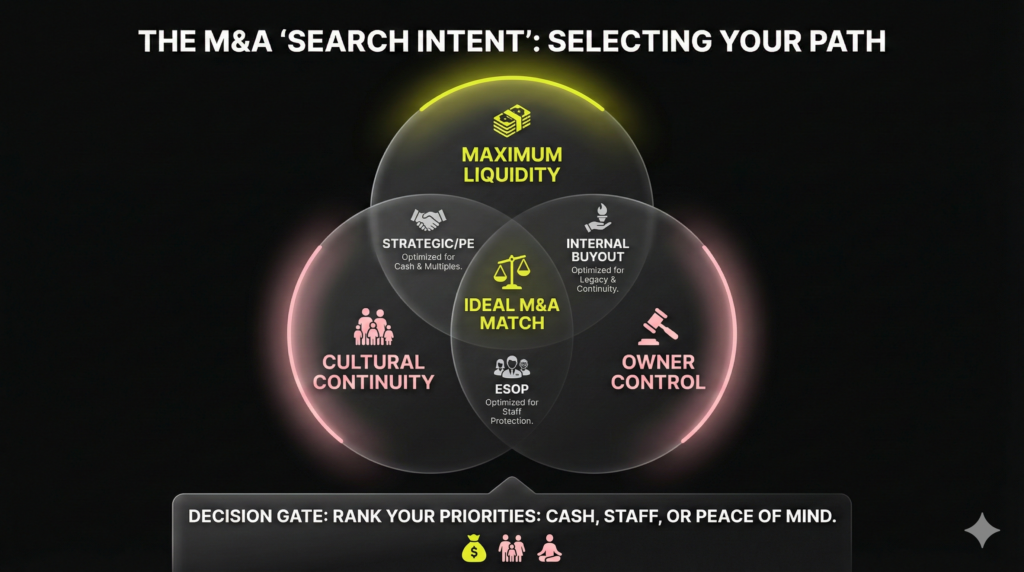
The most critical mistake in retirement planning for MSP owners is defaulting to the first inbound offer. A successful exit requires deliberately managing strategic trade-offs: cash at close vs. control vs. culture. Evaluate your M&A readiness against these primary paths:
- Strategic Buyer/PE: Optimizes for rapid liquidity and high multiples, introducing high integration risk and significant staff upheaval.
- Internal Promotion: Maximize cultural continuity and owner control, but often involves slower, less concentrated cash flow via owner-financed buyout.
- Employee Group (ESOP/Partnership): Protects culture and legacy; requires significant legal complexity and slower external liquidity realization.
Regardless of the chosen route, the transferability of your recurring revenue and guaranteed service continuity for high-LTV clients remain the universal make-or-break factors for maximizing valuation. To engineer your exit, rank your top two priorities now, cash, staff retention, or client peace of mind, and avoid the default option that merely showed up first.
7. Master the Deal Structure: Prioritize Certainty Over Headline Price
The high valuation multiple is worthless if the deal structure prevents access to net proceeds. Retirement planning for MSP owners is about maximizing certainty as much as price. Define your non-negotiables before signing a Letter of Intent (LOI):
- Asset vs. Stock Sale: Understand the buyer's preference; the tax basis and liability implications differ drastically.
- Earn-outs: These are dangerous. Tie them to clear, controllable metrics (e.g., MRR renewal rate, not EBITDA growth). Ensure operational control to hit targets and seek protective liability caps.
- Escrow and Holdbacks: These delay liquidity, protecting the buyer against breaches of your Representations and Warranties. Minimize the term and the percentage held back.
Advanced Consideration: The QSBS (Qualified Small Business Stock) exclusion can eliminate millions in capital gains taxes, but it requires specific entity and stock-holding compliance that must begin years before M&A readiness. Do not treat this as a last-minute switch.
Document your "Terms Wishlist" and hand it to your M&A advisor. The structure, not the headline price, dictates your retirement timeline. (152 words)
8. Ensure Contract Transferability: De-Risking Your Recurring Revenue
Discovering critical client agreements are non-transferable after signing an LOI is a prime source of deal friction and the fastest way to incur a valuation haircut. A buyer's valuation relies entirely on the bankability of recurring revenue; non-transferable contracts lead to immediate risk discount.
To ensure high M&A readiness and seamless transfer during diligence, focus on contractual hygiene today. Begin a lean review of client MSAs/SOWs, focusing on assignment, novation, and change-of-control clauses. Confirm core vendor agreements (RMM, PSA, security tooling) are transferable or re-paperable.
Map your top 10 accounts to relationship owners other than yourself, documenting Quality Business Review (QBR) history to prove institutional, not personal, client relationships. Do not wait for diligence to surface this foundational risk; contractual clarity is a mandatory pre-exit audit item.
| Exit path | Optimizes for | Main trade-off |
|---|---|---|
| Strategic buyer or PE | Rapid liquidity and high multiples | High integration risk and staff upheaval |
| Internal promotion | Cultural continuity and owner control | Slower, owner-financed cash flow |
| Employee group (ESOP/partnership) | Culture and legacy protection | Legal complexity and slower external liquidity |
The 90-Day Execution Plan for Engineering Your MSP Exit
Succession is a marathon, but the first 90 days must be a sprint. This strategic roadmap converts abstract retirement planning intent into an executable schedule designed to maximize M&A readiness by establishing clarity, mitigating risk, and securing your professional team.
Weeks 1 to 2: Define Your Foundation and Target
Phase 1 establishes the personal metrics that dictate business actions. The deliverable is a clear understanding of your minimum liquidity requirement.
- Calculate Your Freedom Number: Conduct a personal balance sheet gap analysis (referencing Tip #1). Determine the required net proceeds after estimated taxes and fees.
- Set the Exit Timeline: Define your firm exit window (e.g., 18, 36, or 60 months). Identify non-negotiable terms for the eventual deal structure.
- Outcome: A quantifiable enterprise valuation target and a committed timeline for your retirement planning for MSP owners.
Weeks 3 to 6: Operationalizing Value Drivers
Focus on institutional capability. Proving repeatability eliminates massive Keyman Dependency discounts during diligence.
- Baseline Readiness: Establish the core dashboard tracking recurring revenue mix, adjusted EBITDA margin, and client churn (referencing Tip #3).
- Systematize Expertise: Complete the Keyman Dependency assessment. Create SOPs for QBRs and technical escalations, ensuring staff owners handle execution, not the founder.
- Draft the Value-Driver Plan: Outline the 3 to 5 levers that will increase your defensible valuation range in the next 12 months (e.g., achieving a 20% net MRR gain).
- Define Successor Track: Select a successor development path (internal promotion plan or external hire profile).
- Outcome: A proven, repeatable delivery system documented for buyer review.
Weeks 7 to 10: Advisory and Structural Choices
Secure the professional expertise necessary to navigate the tax and legal complexity of a final transaction.
- Interview the Triad: Conduct structured interviews with an M&A attorney, a CPA specializing in transactional tax, and a third-party valuation specialist. Define clear roles and fees.
- Choose the Exit Path: Select your likely exit route (Strategic, PE, or Internal), based on the Trade-Off Matrix (referencing Tip #6). Define what "good terms" means regarding culture versus liquidity.
- Outcome: A vetted advisory team and consensus on the target deal structure.
Weeks 11 to 13: Paperwork and People
Finalize contractual hygiene to de-risk the asset and prepare key stakeholders for eventual communication.
- Contract Transferability Review: Audit the top 10 client MSAs and vendor agreements (referencing Tip #8). Ensure seamless assignment or novation clauses are present. Fix non-transferable agreements immediately.
- Stakeholder Communications Outline: Draft the internal and external communication plan, defining who hears what, when, and from whom.
- Final Deliverable: Create a one-page “Retirement + Succession Operating Plan.” Include target dates, owners for each value driver, and required quarterly cash flow metrics.
- Outcome: A controlled communication strategy and complete M&A readiness checklist.