If you are attempting to grow your service firm by copying high-volume spammy link building tactics, stop. That playbook fails. Managed service providers (MSPs) rely on deep local trust and targeted relevance, not link volume. Your true goal is targeted Domain Authority: visibility for "managed IT + city/vertical" and becoming a trusted citation for AI Search models (LLMs). This requires a unique approach to link building for MSP. Learn 10 MSP-adapted tactics and a 90-day rollout plan, backed by insights from AI Search experts like NUOPTIMA. Start with the sources buyers already trust.
Key Takeaways
- MSP link building should target relevance and trust, not link volume; one strong link from a vendor portal or vertical site beats dozens of generic directory listings.
- Always point links to a specific service or city page, not the homepage, to maximise topical relevance and support high-intent local queries like "managed IT Chicago".
- Standardise NAP across Google Business Profile, Bing Places, and Yelp first, since inconsistent citations damage local pack visibility before any outreach begins.
- Vendor partner portals (Microsoft, Datto), HARO quote banks, and earned media appearances are the highest-leverage sources because buyers already trust them.
- The 90-day rollout runs in phases: NAP cleanup and link targets (weeks 0 to 2), vendor and reclamation wins (3 to 6), sponsorships and niche directories (7 to 10), then earned media and flagship assets (11 to 12).
Link building for MSP is the practice of earning relevant, high-trust backlinks from vendor portals, local citations, and vertical publications to raise an MSP's local authority and AI Search citations.
1. Leverage Vendor Partner Portals for High-Trust Backlinks
Leverage vendor partner portals, platforms buyers already use, for high-trust, authoritative backlinks aligned with your service offering. This is high-leverage link building for MSP.
Go beyond basic registration. Fully optimize your profile on every vendor partner directory (e.g., Microsoft, Datto) with a descriptive bio, geographical focus, and, critically, a deep link to a specific service page. Linking to your "Cybersecurity Solutions" page (vs. the homepage) maximizes topical relevance. Since buyers use these pages late in the Consideration/Decision stages, referral traffic is high-intent.
To execute, follow this tight checklist:
- List current and target vendors; confirm listing requirements.
- Draft a conversion-safe bio detailing services, verticals, and local geography.
- Ensure the link points specifically to a core service page (not the homepage).
Pitfall: An existing listing links to an outdated or generic URL. KPI: Monitor partner-directory referral traffic and impressions for vendor-intent queries to measure the authority lift.
2. Standardize Your NAP Across Core Local Citation Profiles
Inconsistent Name, Address, and Phone (NAP) information across directories creates conflicting entity signals, severely damaging local pack visibility. For MSPs targeting "IT services near me," reliable citations are table stakes for establishing trust and effective link building for MSP.
To ensure clear data transmission, establish one canonical identity across essential profiles, including your Google Business Profile (GBP), Bing Places, Yelp, and local Chamber of Commerce.
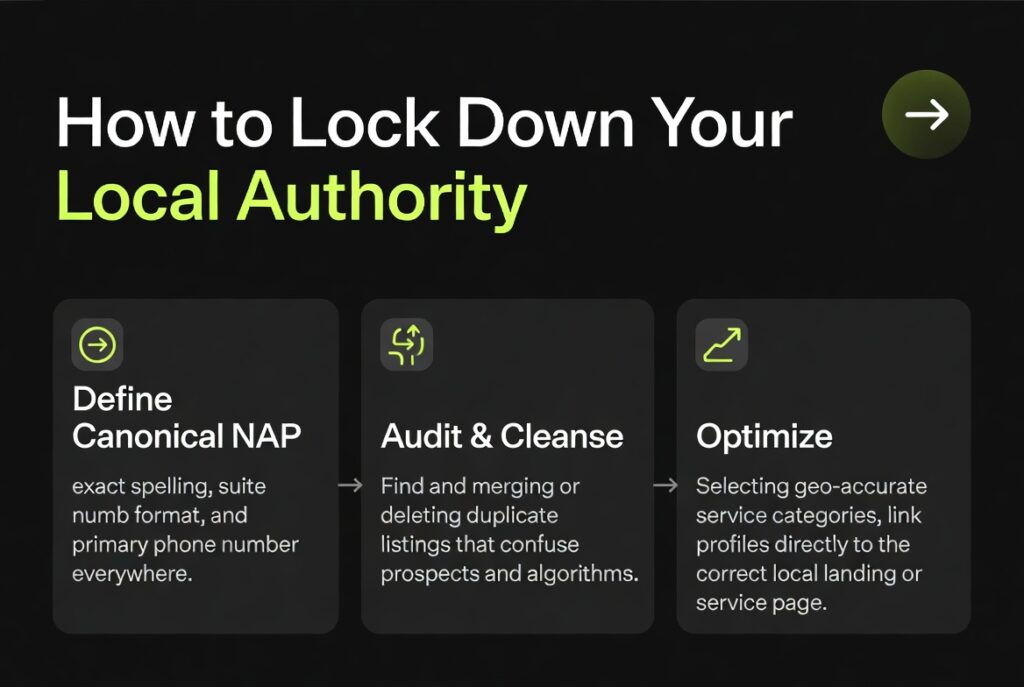
To lock down your local authority:
- Define Canonical NAP: Use the exact spelling, suite number format, and primary phone number everywhere.
- Audit & Cleanse: Find and merge or delete duplicate listings that confuse prospects and algorithms.
- Optimize: Select geo-accurate service categories and link profiles directly to the correct local landing or service page.
Focus on citation consistency over raw quantity; adding dozens of inconsistent junk directories dilutes, rather than strengthens, local authority.
3. Convert Local Sponsorships into Contextual Backlinks
Standard sponsorships often feel like necessary donations, yielding goodwill but minimal measurable SEO uplift (often just a nofollow link buried in a PDF). To transform this budget line item into strategic, local link building for MSP, focus on securing indexed, contextual placements that deliver measurable authority and influence.
Map local nonprofits, chambers, or industry events aligned directly with your target verticals (e.g., legal associations, manufacturing trade groups). When negotiating tiers, ensure you receive an on-site sponsor page mention, not just a static logo placement in an unindexed gallery.
The Critical Request: Ask the host to include a brief, descriptive sentence alongside your logo, linking to a specific service page (such as your cloud infrastructure or compliance solution). These descriptive ‘narrative fragments’ reinforce your topical authority and local relevance for search engines. A logo-only image or a non-indexed PDF link is a significant pitfall; demand context and an indexable page.
KPI: Measure the authority lift by tracking the number of indexed sponsor placements, resultant local referral visits, and assisted conversions.
4. Create High-Authority Local Pages to Act as Link Targets
Linking local citations and sponsorships to your generic homepage dilutes link equity, preventing you from ranking for high-intent local queries. Instead, build a clean /locations/ structure featuring robust, high-conversion city or vertical landing pages as part of a wider MSP content strategy designed for conversion.
This strategy ensures local link building for MSP efforts directly support revenue-driving queries (e.g., "managed IT Chicago"). These pages must include MSP-specific content:
- Detailed service scope and security credibility.
- Local case studies or testimonials.
- A clear call-to-action (assessment or consult).
These deep, optimized pages replace dozens of thin, auto-generated location listings, providing a superior destination for inbound links. The KPI for this tactical pivot is simple: measure impressions and clicks for "city + managed IT" terms, alongside lead conversions generated specifically from these local landing pages.
5. Earn Authority Quotes from Journalists Using a Rapid-Response Quote Bank
Link building for MSP authority demands third-party validation that positions your executives as national experts. The most efficient method for achieving high-DA mentions is by responding rapidly to journalist source requests (e.g., HARO). Digital PR tactics like HARO responses are a core part of professional off-page SEO services.
Security incidents, CMMC compliance, and incident response are inherently newsworthy, giving MSPs a clear advantage in cybersecurity lead generation by positioning expertise against real-world risks. Execute this tactic at scale by prioritizing speed and relevance. Implement a daily review cadence, immediately discarding requests outside your specialty (ransomware, M365 security).
The crucial step is establishing a "quote bank", a pre-vetted document containing short, punchy opinions (under 50 words) backed by verifiable statistics. When responding, optimize for placement by including three elements:
- The executive's credential line.
- A concise, 1-sentence recommendation.
- A deep link to an authoritative service page on your site.
Pitfalls are simple: overly promotional answers or slow replies. Tracked monthly authority mentions and subsequent referral traffic serve as the primary KPI.
6. Execute Targeted Guest Posting on Vertical and Local Sites
We must shift link building for MSP away from generic, low-relevance marketing blogs. To earn high-leverage links, publish educational articles precisely where buyers already read: vertical sites (e.g., healthcare admin journals, financial compliance newsletters) and local business publications. Targeted guest posting on high-relevance sites is one of the most powerful levers. For example, Nuoptima secured high-quality backlinks for cybersecurity consultancy Eden Data through strategic guest posts and collaborations.
Focus exclusively on non-promotional thought leadership. Use a simple pitch formula: identify a specific problem, offer practical steps (like managing data security), explain the necessary risk reduction (e.g., achieving HIPAA compliance), and detail the measurable business outcome.
When placing links, use a relevant deep link (e.g., incident response checklist or city-specific service page) leading readers directly to a high-value asset. Keep anchors natural, avoiding exact-match repetition. Your KPI is not placement volume, but verifying the host article ranks for relevant queries, ensuring the link provides ongoing leverage.
7. Reclaim Lost Link Equity via Mention Monitoring
Link Reclamation is the fastest, lowest-effort link building for MSP strategy. It maximizes existing link equity by identifying unlinked brand mentions or incorrect URLs and requesting simple correction. You convert existing awareness into measurable authority without chasing net-new domains.
MSPs commonly find reclaimable links on vendor pages, local chamber listings, event pages, partner announcements, and local news coverage.
Execution Steps:
- Set Alerts: Monitor brand and key executive names using Google Alerts or tools like Mention.
- Build Tracking: Record the original page URL, contact, and the desired deep link target in a centralized spreadsheet.
- Outreach: Send a short email providing the exact URL and suggested anchor/target to simplify the correction process.
Pitfall: Never ask for a generic homepage link. Prioritize relevant service, compliance, or city pages for stronger topical relevance. Measure success using reclaimed links per month and the improved relevance of your backlink profile.
8. Publish Flagship Assets Built Specifically to Earn Citations
MSP marketing collateral often focuses on lead capture, missing the most powerful organic link building for MSP: being the definitive citation authority. Publish 1 to 2 flagship assets so valuable and specific that industry writers and associations must cite them.
Focus on evergreen, high-risk topics relevant to your target vertical (e.g., “Ransomware Readiness Checklist for Healthcare,” CMMC guidance pages, or an Incident Response Runbook Template).
To ensure these assets earn links:
- Make it Citeable: Ensure clear headings, provide a downloadable format (PDF), and embed a “How to Reference This” snippet specifically for journalists/partners.
- Outreach Pivot: Pitch the asset to vertical associations and thought leaders, emphasizing how it simplifies compliance or security matters for their readers.
This strategy strengthens topical authority and boosts your overall backlink profile. KPI: Track referring domains citing the asset, plus assisted leads driven from downloads to consults. To maximize citation potential in both traditional search and AI-powered answers, combine flagship assets with Generative Engine Optimization (GEO). Understanding the nuances of GEO vs SEO is critical for capturing visibility in modern AI search environments.
9. Secure High-Relevance Links from Niche Directories
Stop wasting time on generic, low-authority listings that never index. For effective link building for MSP, your focus must shift from sheer quantity to quality, prioritizing vertical directories and industry associations where buyers actively vet vendors.
To maximize impact, target reputable sources like security, compliance, or local business organizations that demonstrate clear editorial standards. Prioritize high topical, vertical, and regional relevance.
When executing listings, standardize your company bio and service categories. Crucially, use deep links to your specific compliance or vertical landing pages to maximize topical authority, keeping your NAP consistent across all core profiles.
Pitfall: Spreading effort across low-quality directories dilutes trust. Focus on refreshing reputable listings quarterly with new certifications or case studies. Your KPI is simple: achieving indexed listings that drive referral traffic and yield a measurable branded search lift.
10. Bundle Earned Media Appearances into a Repeatable Backlink Engine
Constant guest posts yield slow velocity for link building for MSP. Shift to high-leverage earned media appearances (podcasts, webinars, virtual events) to build topical and entity authority rapidly. Hosts publish show notes or speaker bios that include high-authority, contextual backlinks. This motion builds the specific entity authority (CEO/CTO + MSP brand + expertise) needed to influence AI Search summaries.
Execution for Repeatable Link Motion:
- Talk Tracks: Define 2 to 3 core specialties (e.g., ransomware response, CMMC compliance, cloud governance).
- Standardized Assets: Create a fixed bio, headshot, and deep links targeting relevant service pages.
- Post-Publishing Push: Promote the episode/webinar immediately. This drives traffic to the host’s page, signaling search engines that the backlink profile is authoritative.
The critical pitfall is appearing on shows without an indexed episode page. Secure indexed show-note links, monitoring the resultant branded traffic lift as your primary KPI.
Anchor Text and Backlink Monitoring: Keep the Profile Clean
The anchor text pointing at your pages and the cadence you use to audit new links decide whether the ten tactics above build authority or quietly invite a penalty. Google reads anchor text as a relevance signal, so an MSP that lets every backlink read "managed IT services Dallas" looks manufactured. Keep the mix natural and weighted toward your brand.
- Branded and naked anchors: Lead with your firm name and bare URLs (NUOPTIMA, nuoptima.com). These should be the majority of your profile and never trigger scrutiny.
- Partial and topical anchors: Mix in descriptive phrases like "their incident response playbook" or "CMMC compliance services" that name the topic without repeating an exact money keyword.
- Exact-match anchors: Use sparingly, only from genuinely relevant vendor or vertical pages, and never as the dominant pattern.
- Deep-link targets: Point anchors at the specific service, compliance, or city page they describe, not the homepage, so the relevance signal lands where it earns rankings.
Quality still beats quantity, but judge it by relevance rather than a single authority score. A link from a regional Microsoft partner directory or a healthcare compliance publication your buyers actually read outweighs a stack of generic listings, even when the generic sites report a higher metric. Weigh topical fit, editorial standards, whether the page indexes, and whether real referral traffic follows, before you weigh any authority number.
Run a monitoring cadence so the profile stays clean as it grows:
- Monthly: Pull new and lost backlinks in Google Search Console and your backlink tool. Confirm reclaimed and vendor links landed with the anchor and target you asked for.
- Quarterly: Review the full referring-domain list for irrelevant, spammy, or scraped links, and refresh niche directory listings with new certifications or case studies.
- As needed: Disavow only clearly toxic or negative-SEO links; most low-quality links are safe to ignore, and over-disavowing can remove links that were helping.
Through 2026, treat this audit as governance rather than cleanup. A firm like NUOPTIMA logs anchor distribution and referring-domain quality each quarter so the profile compounds instead of drifting.
Link building for MSP success requires sequenced tactics built on foundations and high-trust sources. Use this 90-day plan to convert strategies into an accountable schedule designed for predictable, fundable growth.
Prerequisites: Define resources by targeting 1 to 3 cities, 1 to 2 verticals, and your primary link targets (specific city or core service pages like Compliance or Incident Response).
Weeks 0 to 2: Foundation and Local Data Cleanup
This foundational phase builds essential local trust required for successful scaling and maximizes the benefits of local SEO.
- Audit and Correct NAP: Clean core citations (GBP, Yelp, Bing Places). Ensure canonical Name, Address, and Phone consistency across all platforms. Eliminate duplicate listings.
- Launch Link Targets: Launch or upgrade /locations/ pages and 1 to 3 high-conversion city pages. These pages must serve as the deep links for all subsequent outreach efforts.
Outcome: Full NAP consistency across core platforms; 3+ optimized local landing pages live.
Weeks 3 to 6: Secure High-Trust Wins
Leverage existing high-trust relationships to immediately impact your backlink profile and secure valuable, relevant anchor text.
- Vendor Optimization: Optimize profiles on all vendor partner portals (e.g., Microsoft, industry partners). Secure deep links pointing to relevant core service pages, such as cloud or compliance solutions.
- Reclamation Blitz: Identify 10 to 20 unlinked brand mentions (from local press, partners, or events). Outreach immediately to convert these mentions into active, relevant backlinks.
Outcome: All vendor listings updated with deep links; 5 to 10 successful link reclamations completed.
Weeks 7 to 10: Scalable Local Authority
Transition the program from cleanup efforts to proactive, scalable local authority generation.
- Contextual Sponsorships: Secure 2+ local community or vertical PR sponsorships (e.g., association memberships). Require indexed sponsor pages with contextual links to core service pages (e.g., cybersecurity or managed network solutions).
- Niche Directory Wins: Secure 1 to 2 high-relevance niche directory or association listings per week. Prioritize topical relevance over general volume.
Outcome: 2+ indexed, contextual sponsorship links secured; 4 to 8 high-relevance vertical directory listings finalized.
Weeks 11 to 12: Earned Media and Amplification
Accelerate expert positioning efforts to drive high-DA authority mentions and secure earned media.
- Quote Bank Deployment: Establish a rapid-response cadence for journalist requests (HARO/SourceBottle). Use pre-vetted quotes to secure 2+ placements related to security or incident response.
- Asset Launch: Publish one flagship asset (e.g., a CMMC compliance guide or security benchmark report). Initiate targeted outreach to industry thought leaders and associations to encourage citation.
Outcome: 2+ authority mentions secured in external media; 1 flagship asset published and pitched.
Governance and Tracking
Maintain steady, managed link velocity; avoid sudden, unsustainable bursts. Track success by monitoring referring domains to priority pages, local pack visibility, and the quality of leads driven by referral traffic. Successful Link building for MSP programs require continuous governance.
Proven results from these tactics:
Cortavo, a managed service provider, used targeted link building combined with authority-focused SEO. Similarly, cybersecurity firm Microminder (closely aligned with MSSP/MSP models).