Stop running ad-hoc audits that fail to scale. A professional seo page comparison isolates why a competing URL wins by measuring it against your target URL. By analyzing intent coverage, entity structure, and link trust, you transform raw data into a prioritized execution backlog. This repeatable workflow allows teams to automate optimizations across hundreds of pages, making it ideal for enterprise SEO campaigns that require securing rankings and critical AI citations. Start by choosing the right two pages to compare.
Key Takeaways
- A valid SEO page comparison requires matched pages: align query intent, funnel stage, and page type, and analyze the specific ranking URL rather than the root domain, or the data is noise.
- Every audit should produce a 2-URL brief containing the target URL, competitor URL, query, intent, and one success metric, which keeps optimization tied to pipeline impact.
- Treat the comparison as a deterministic technical diff across title, meta, H1/H2 map, word count, canonicals, indexability, and schema, output as a normalized table flagging "missing," "weaker," or "broken."
- When content is sound but stalled on page two, run a link intersect analysis to isolate the authority gap, since the limiter is often off-page trust rather than on-page relevance.
An SEO page comparison is a diagnostic method that audits a target URL against a competing ranking URL across intent, technical structure, content, and link trust to identify why the competitor wins and build a prioritized fix list.
1. Audit Only What Matters: The Valid Comparison Rule
Most SEO audits fail because practitioners compare mismatched pages. For a precise seo page comparison, you must align query intent, funnel stage, and page type. Comparing transactional product pages to informational blogs creates noise and wastes engineering cycles.
Use this checklist to ensure data integrity:
- Match the exact query, country, and device.
- Analyze the specific ranking URL rather than the root domain.
- Identify SERP features like AI Overviews, featured snippets, or review stars that influence visibility.
Every audit must yield a 2-URL brief containing the target URL, competitor URL, query, intent, and success metric. This discipline prevents drawing false conclusions and ensures optimization efforts directly impact the pipeline.
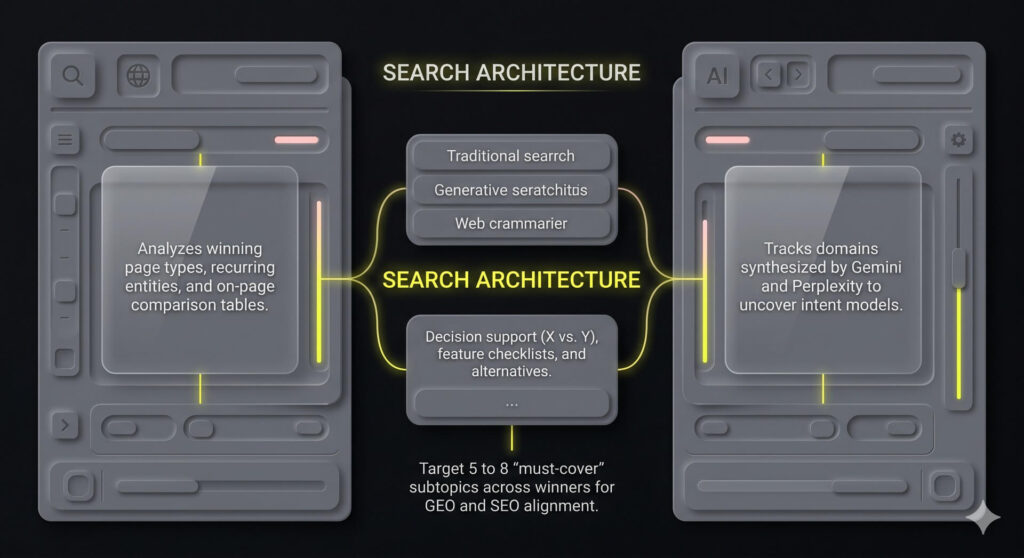
2. Map the Search Architecture: Google vs. AI Synthesis
High authority no longer guarantees dominance. To outrank leaner competitors, map the search architecture by analyzing what Google rewards and what AI engines cite. Snapshot the SERP to identify winning page types, recurring entities, and comparison tables for your query set.
Audit the AI layer by recording which domains Gemini and Perplexity synthesize. This SEO page comparison reveals the underlying intent model:
- Decision support (X vs. Y)
- Feature checklists
- Alternatives
Identify 5 to 8 “must-cover” subtopics common across winners. Engineering high-density content for both legacy algorithms and Generative Engine Optimization (GEO) ensures you optimize for the page the SERP rewards, rather than the page you wish ranked.
3. Standardize the Technical Diff
Minor on-page misalignments often create an aggregate authority gap that suppresses superior content. To fix this, treat the seo page comparison as a deterministic diff. Extract and map these fields side-by-side:
- Title tag and meta description
- H1/H2 map and word count
- Canonicals, noindex, and indexability status
- Structured data schema presence
Use specialized URL compare tools for quick diffs or Screaming Frog exports for site-wide repeatable extraction. The output must be a normalized comparison table featuring “missing,” “weaker,” or “broken” flags. This replaces subjective page reviews with an engineering brief ready for Jira or Linear. Standardizing this process ensures your technical architecture is engineered for the answer layer.
4. Inventory Content Gaps for Entity Dominance
Stop tweaking keyword density; modern search requires a focus on semantic SEO. A modern seo page comparison requires a section-level inventory of modules used by top competitors to satisfy intent. Identify missing blocks like:
- Use cases and pricing notes
- API integrations and limitations
- FAQ blocks and social proof
Modern retrieval systems and AI summarizers scan for entity completeness rather than word count. Map required entities, including features, standards, and metrics, that repeat across winning URLs.
Apply the upgrade rule: add missing sections to reach topical parity before deepening thin content with unique data. Your output is a backlog ranked by (intent impact) × (effort). This infrastructure ensures AI engines trust and cite your brand as the definitive answer.
5. Structure for Comparison Page SEO: The Table-First Architecture
Dominating seo page comparison rankings for “X vs Y” or “alternatives” terms requires shifting from narrative content to structured data architecture. Start with a direct H1 and a verdict module above the fold to satisfy intent and capture AI citations.
Deploy a comparison matrix with these standardized rows:
- Pricing and key features
- Integrations and support
- Ideal use case and constraints
Anchor the content with a schema stack including Product, FAQ, Review, and AggregateRating markup. Ensure on-page claims match your structured data to prevent citation drops. This table-first blueprint transforms comparison pages into high-density assets that search engines and LLMs can parse, trust, and recommend to your buyer pipeline.
6. Isolate the Authority Gap: Link Intersect Analysis
If content is technically sound but stalled on page two, you likely face an authority deficit. A thorough seo page comparison must distinguish between relevance (on-page) and trust (off-page) to prevent over-optimizing content when the true limiter is mentioned.
Use a link intersect tool to identify domains pointing to multiple competitors and focus on page-level referring domains to build an outreach list. This strengthens entity authority and expands your citation pool for generative engines. When LLMs see your brand cited by established sources, they are more likely to synthesize your content into AI-generated answers. This ensures authority building stays tied to the specific page topic rather than generic acquisition.
7. Scale with Guardrails: The Automation Framework
Scaling an seo page comparison strategy requires automation focused on extraction and section diffing. Authority-led teams use these signals to generate engineering tickets rather than auto-publishing templated fluff. This maintains technical integrity and ensures pages remain citation-ready for generative engines.
Protect entity authority by enforcing strict uniqueness guardrails. Every page must include original data, proprietary screenshots, or tailored FAQs to provide distinct value. Deploy a hub and spoke internal linking model to prevent orphan pages and consolidate topical power across your architecture.
Follow this ship checklist to ensure quality:
- Indexability: Verify correct canonicalization and discovery.
- Uniqueness: Confirm original data or specific examples are present.
- Internal Links: Connect the page to its strategic topical hub.
- Update Cadence: Schedule automated refreshes to preserve data freshness.
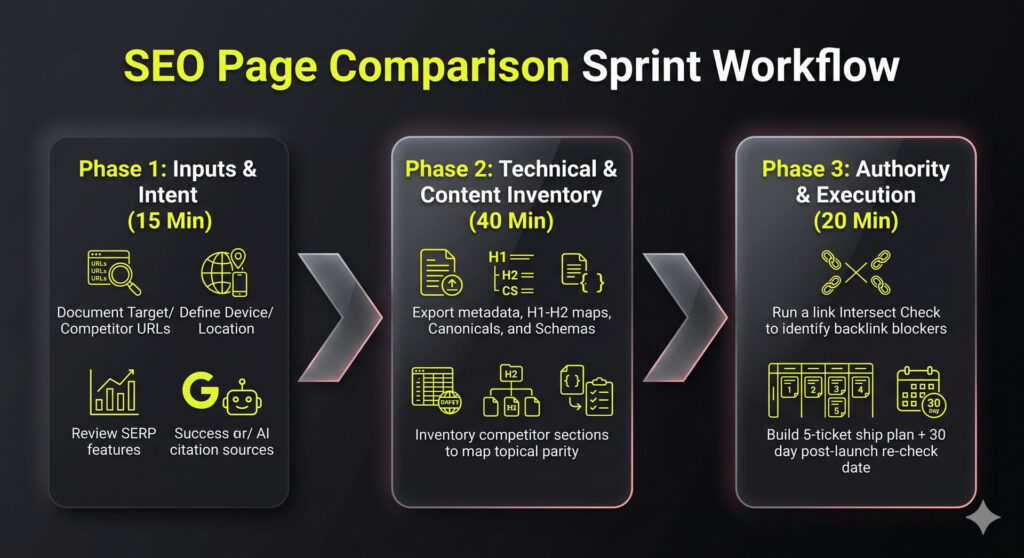
How to Execute an SEO Page Comparison: A 75-Minute Sprint
Use this high-velocity operating procedure to turn audit data into a ship-ready plan.
Phase 1: Inputs and Intent (15 Minutes)
- Gather Inputs (5 min): Document the target query, target URL, and primary competitor URL. Define the specific device and location. Select one success metric: ranking, CTR, or lead volume.
- Analyze SERP Intent (10 min): Review SERP features, AI Overviews, and repeated entities. Note which sources Perplexity or Gemini cite. You will identify the authority model the LLMs currently prioritize.
Phase 2: Technical and Content Inventory (40 Minutes)
- Technical Audit (20 min): Export titles, H1-H2 maps, canonicals, schema, and word counts. Flag missing tags or broken elements. Significant word count gaps often suppress visibility in the answer layer.
- Content Inventory (20 min): Inventory the competitor’s sections. List missing requirements such as comparison tables or FAQ gaps. Ensure your page achieves topical parity.
Phase 3: Authority and Execution (20 Minutes)
- Authority Check (10 min): Run a link intersect check to compare backlink profiles. Determine if link gaps act as a blocker or if content updates alone can drive movement.
- Build a Ship Plan (10 min): Create a 5-ticket backlog based on impact and effort. Assign owners to each task. Set a re-check date for 30 days post-launch.
Contact NUOPTIMA for expert SEO and GEO execution to dominate search.
FAQ
A seo page comparison is a diagnostic methodology used to audit two specific URLs and identify ranking gaps. Comparison page SEO refers to the technical and content optimization of “X vs. Y” or “Alternatives” assets. Most growth teams use the comparison method to audit their current visibility and then apply the page-type framework to build high-converting assets that capture bottom-funnel intent.
Use page-level diff tools or crawlers like Screaming Frog to extract and compare HTML, meta tags, and schema architecture side-by-side. For off-page data, use Semrush or Ahrefs to perform link intersect analysis and identify keyword gaps. These tools allow you to isolate exactly why a competitor URL holds a position and which technical or authority signals your page currently lacks.
Google penalizes low-utility, templated pages that offer no unique value to the user. To mitigate this risk, ensure every page features proprietary data, unique insights, or specific use-case examples. Maintain a hub-and-spoke internal linking model and monitor the ratio of crawled versus indexed pages. High-quality comparison pages that provide genuine decision support are favored by both search algorithms and AI engines.
Monitor rankings and click-through rates for high-intent queries, but prioritize bottom-funnel conversions like demo requests and assisted pipeline. For brands focusing on Generative Engine Optimization (GEO), track your frequency of citations in AI Overviews and mentions within generative search tools over time. These metrics confirm that your content is being synthesized as the authoritative answer for your target query set.
Build trust by acknowledging competitor strengths and defining specific use cases where a competitor might be a better fit. Keep all pricing and feature data current to prevent user friction. Add social proof, such as verified reviews or case studies, and ensure on-page claims match your structured schema data. This technical transparency helps search engines and LLMs validate your brand as a reliable source.
Ready to dominate search and the answer layer? Contact NUOPTIMA for expert SEO services and GEO execution to scale your organic revenue.
Where this fits in your MSP growth system
This is one piece of how NUOPTIMA makes MSPs and cybersecurity firms the provider buyers find on Google and in AI search. See how it connects to MSP SEO and GEO and AI-search, or get your free MSP lead forecast to see exactly where your firm shows up across ChatGPT, Gemini, and Perplexity today.