AI search is no longer a ranking race but a source-selection problem. To secure a high geo ranking, your brand must transition from being indexed to being cited in the answer layer. Visibility now favors sites that are easy to ground with verifiable entity facts, easy to match via semantic relevance, and safe to trust through local authority. This guide operationalizes six technical levers and a 90-day execution sprint. For scale, Nuoptima provides deeper support through specialized GEO services, alongside tailored SEO for MSPs looking to scale their overall visibility.
Generative engine optimization (GEO) is the practice of getting your brand cited as a source inside AI-generated answers from ChatGPT, Gemini, Perplexity, and Google AI Overviews. It is real, and it is not replacing SEO. It sits on top of it: classic ranking signals still feed the model, but selection now depends on whether your facts are verifiable, structured, and easy to ground.
Key Takeaways
- Generative engine optimization (GEO) is getting your brand cited as a source inside AI answers from ChatGPT, Gemini, Perplexity, and Google AI Overviews; it sits on top of SEO rather than replacing it.
- For MSPs and cybersecurity firms, buyers ask an AI 'who's the best MSP in my city' long before filling in a form, so being the named answer is the new top of funnel.
- AI visibility depends on three things: verifiable entity facts that are easy to ground, semantic relevance, and local authority that makes your brand safe to trust.
- Eliminate data friction by keeping NAP, hours, service categories, and coordinates identical across your site and Google Business Profile, then reinforce them with LocalBusiness, GeoCoordinates, and Organization schema.
- Open robots.txt to crawlers like GPTBot, keep a fresh refresh cadence on local pages, and package content into standalone answer blocks under question-style subheads so models can extract and cite it.
Why it matters for MSPs and cybersecurity firms
- Buyers with long sales cycles ask an AI "who's the best MSP in my city" long before they ever fill in a form, so being the named answer is the new top of funnel.
- Referral-dependent firms have no presence in that answer layer, which means competitors get recommended in conversations you never see.
- You sell AI competence, so an invisible-to-AI website undercuts the expertise you charge for.
Our test is blunt: run the actual buyer prompts across four LLMs, see if you're named, then close the entity and corroboration gaps until you are. We took Microminder from $0 to $1M+ this way, which our GEO services run end to end.
1. Aligning AI Visibility with Local Infrastructure
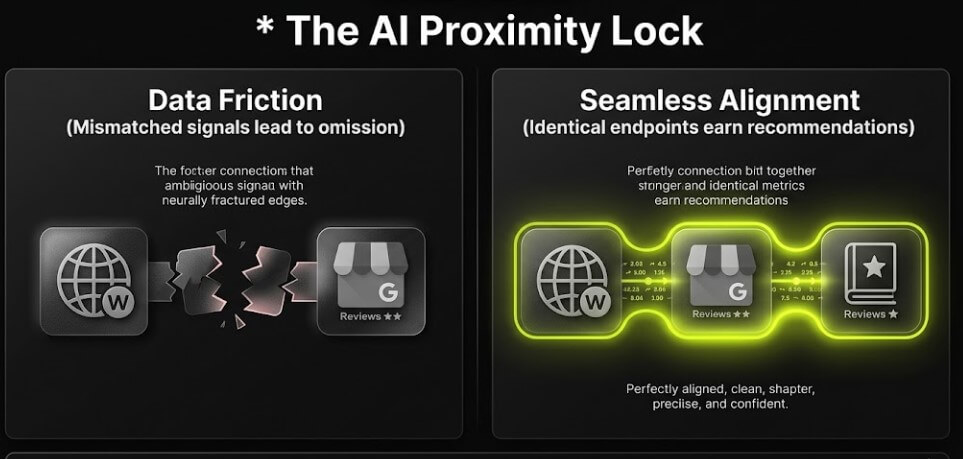
Your brand loses high-intent leads when it remains invisible in “near me” AI prompts. Traditional page-one rankings do not guarantee AI citations if local signals are ambiguous. Assistants like Gemini and Perplexity prioritize businesses with verified physical mapping to mitigate hallucination risks. If on-site data contradicts your Google Business Profile (GBP), models skip your brand for safer, consistent alternatives.
To improve geo ranking, eliminate data friction between your GBP and landing pages. Ensure the following elements are identical across all platforms:
- Business Name, Address, and Phone (NAP)
- Operating hours and service categories
- Service area definitions and coordinates
Integrate explicit geo signals into your page architecture through embedded address blocks and canonical location URLs. Mismatched addresses or duplicate location pages are common failure modes that force AI systems to choose competitors. Consistent entity endpoints provide the certainty these systems require to recommend your business for proximity-weighted prompts.
2. Engineering Semantic Relevance for Service Entities
AI assistants prioritize service entities they can verify with high confidence over keyword-stuffed pages. While traditional search matches strings, LLMs map conversational intent to specific entities. To dominate geo ranking, align your entity architecture with service definitions that AI retrieves as standalone facts.
Refine your taxonomy by selecting one primary category and three tightly scoped secondary services. Maintain identical naming across your website, GBP, and directories, which is a core tenet of effective local SEO for MSP brands. Consistency across these sources signals to the model that your brand is the definitive match for specific intent.
Structure on-page content as extractable service proofs:
- Use direct statements like “We provide technical SEO in London.”
- Include specific process constraints or service availability.
- Remove filler language that obscures factual retrieval.
Prompt customers for service-specific and location-specific reviews. Reply to every review to reinforce service semantics. This multi-source validation ensures AI engines map your brand to exact service intent rather than broad, non-converting industry terms identified during standard MSP keyword research.
3. Maximizing Digital Prominence via Entity Corroboration
AI models avoid recommendation risk by seeking third-party consensus. In GEO ranking, prominence through corroboration replaces the singular focus on backlinks. LLMs prioritize safe recommendations, cross-referencing your claims against local press, industry roundups, and editorial mentions. Unlinked brand mentions on credible domains serve as decisive trust signals for entity validation.
Build context-rich mentions across sources AI systems routinely retrieve:
- Local press, industry roundups, and partner pages
- Niche directories and authoritative community hubs
- Podcasts and YouTube transcriptions
Prioritize review velocity and sentiment hygiene over raw volume. Specific, high-quality reviews provide the trust patterns LLMs require to verify entity authority. Replacing low-quality citation farms with widespread corroboration ensures your brand becomes the default answer across the open web. This builds prominence in a way AI assistants can confidently reuse, increasing your recommendation probability for high-intent queries.
4. Reducing Ambiguity with Structured Entity Grounding
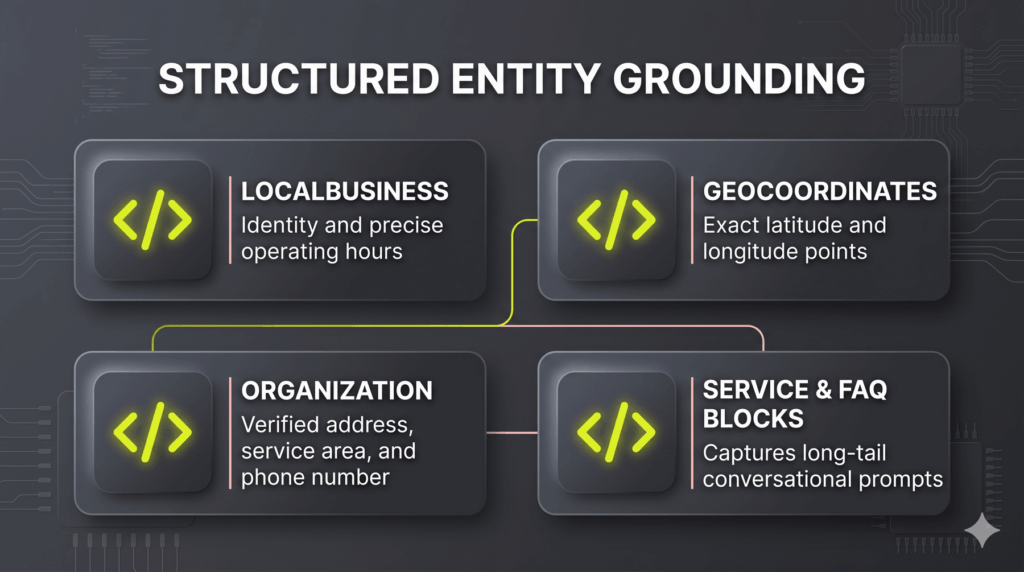
Generative engines hallucinate geographical facts when encountering conflicting data across the web. Conflicting machine-readable facts force AI models to discard your brand to prioritize retrieval accuracy. To secure a stable geo ranking, you must deploy a JSON-LD architecture that serves as a single source of truth. This reduces contradictions across sources and forces higher retrieval confidence from LLMs.
The minimum schema set for geo-ranking contexts includes:
- LocalBusiness (identity and operating hours)
- GeoCoordinates (latitude and longitude)
- Organization (address, service area, and phone)
Integrate Service definitions and FAQ blocks to capture conversational long-tail queries. Mirror Google Business Profile (GBP) fields exactly to maintain entity parity and prevent AI systems from discarding you due to mismatched facts. Validate your markup regularly to prevent data drift in hours or locations. This technical discipline transforms your site into a verifiable entity that AI systems can synthesize and cite without hesitation.
5. Optimizing Retrieval Paths and Content Freshness
Why does high-authority content fail to appear in ChatGPT while Google rankings stay stable? Generative engines use Retrieval-Augmented Generation (RAG) to ground answers in real-time data. If your architecture contains “selection gates” that block crawlers or serve stale info, you are invisible to the answer layer. Visibility is now a retrieval problem.
Technical Checklist for RAG Access:
- Bot Access: Audit robots.txt to ensure agents like GPTBot and OAI-SearchBot can access key directories.
- Sitemap Hygiene: Use accurate lastmod tags and strict canonicals to prevent crawlers from indexing non-authoritative versions.
- Crawl Paths: Eliminate orphaned location or service pages that lack clear internal link structures.
Operationalize a refresh cadence for high-value local pages. AI models prioritize verifiable data regarding pricing, coverage, and service availability. Treating your site as a live knowledge base ensures your brand remains the primary source for RAG-driven local recommendations.
6. Packaging Content for AI Extraction and Citation
Generative engines do not read pages; they extract data. Models skip insights buried in sprawling text for competitors offering standalone answer blocks. Advanced GEO requires packaging content into attributable units that retain meaning out of context. This architecture positions your site as a safer source to cite, increasing selection probability even when you are not the top organic result.
Use question-style subheads mirroring exact prompts. Replace generic “Service Area” headers with specific queries like “How fast can you arrive in London?” or “What does our emergency repair include?” to map data directly to user intent. This creates a clear signal for LLMs searching for definitive service answers.
Integrate specific proof blocks to provide grounding data for AI verification:
- Professional licenses and certifications
- Service guarantees and operational constraints
- Case study snippets and before/after results
Limit neighborhood specificity to operational realities. Avoid generic location stuffing that contradicts your Google Business Profile and signals unreliability to AI systems. This ensures your site remains a high-confidence data source for local service decisions.
A 90-Day Roadmap for Dominating GEO Rankings
Achieving a dominant geo ranking requires a sequenced execution plan. Follow this 13-week schedule to move from indexed status to cited authority.
Week 1 to 2: Entity Parity and Retrieval Health
Perform an entity parity audit between your website and Google Business Profile. Verify NAP consistency and service category symmetry across both surfaces. Review robots.txt files to ensure OpenAI and Gemini crawlers have full access. Update your sitemap with precise lastmod tags to signal content freshness for retrieval systems.
Week 3 to 6: Relevance and Content Packaging
Rebuild location and service pages using extractable answer blocks. Add FAQ schema and JSON-LD markup to define each service entity. Launch review request prompts that encourage customers to use specific service and location language. This provides the semantic evidence LLMs use for brand recommendations.
Week 7 to 10: Authority and Entity Corroboration
Secure five to ten high-quality mentions on local or topical domains. Prioritize brand citations in industry roundups and niche directories. These external signals corroborate your entity identity and increase your prominence score within AI knowledge graphs.
Week 11 to 13: Measure and Iterate
Track brand citations in ChatGPT, Gemini, and Perplexity. Identify pages receiving partial inclusion and refine the content structure for full extraction. Use these measurable checkpoints to iterate on pages with low citation frequency.
For professional execution that moves beyond generic consulting, review nuoptima.com and our GEO services. We provide done-for-you implementation to ensure your brand remains the definitive answer.
FAQ
GEO incorporates core pillars of local SEO like proximity and prominence but applies them to a generative retrieval model. While traditional SEO focuses on ranking in lists, GEO optimizes for the synthesis layer where AI engines cite specific sources. You are competing to be the primary data source for answers.
No implementation guarantees a citation. However, structured data reduces entity ambiguity and increases grounding confidence. For the best results, your schema must remain consistent with your Google Business Profile and off-site corroborations. AI models prioritize sources they can verify through multiple consistent data points. Consistency is the key to citation eligibility.
Measurement requires tracking prompt mentions rather than keyword positions. Monitor how often your brand appears in responses for specific city and service prompts. Success is defined by mentions, active citations, and CTA outcomes. Periodic rechecks across ChatGPT, Gemini, and Perplexity are necessary to account for model updates and shifting retrieval patterns.
No. Blocking AI crawlers removes your brand from the citation pool for systems relying on real-time retrieval. While it protects content from training sets, it also eliminates eligibility for citations in generative answers. Choose intentionally based on whether you prioritize content exclusivity or search visibility.
Engage a partner when managing multi-location complexity or noticing competitors winning citations. If your team needs a measurable program tied to the pipeline, expert intervention is required. Visit Nuoptima or explore our GEO services to build a technical roadmap engineered for the answer layer and consistent pipeline growth.
Where this fits in your MSP growth system
This is one piece of how NUOPTIMA makes MSPs and cybersecurity firms the provider buyers find on Google and in AI search. See how it connects to GEO and AI-search and answer engine optimization, or get your free MSP lead forecast to see exactly where your firm shows up across ChatGPT, Gemini, and Perplexity today.