Search is splitting between traditional Google rankings and the generative answer layer. To dominate, you must master chatgpt seo by playing two parallel games: using LLMs to accelerate strategic decisions and engineering your site as the cited authority in AI responses. Success is no longer about clicks but becoming the definitive recommended source. These 8 concrete tactics for workflow and GEO mechanics ensure your team stops optimizing for the wrong results. Start by separating these two playbooks.
Yes, you can use ChatGPT for SEO, but the real question is whether it will replace SEO, and the answer is no. ChatGPT plays two distinct roles: a workflow tool that speeds up research and drafting, and a new answer layer where being the cited source matters. Optimizing for it means engineering your site to be the source ChatGPT recommends, not just feeding it prompts.
Why it matters for MSPs and cybersecurity firms
- Prospects increasingly ask ChatGPT for vendor shortlists, so the named recommendation often forms before a buyer ever lands on your site.
- Referral-led firms are invisible in those conversations and lose deals they never see.
- Selling AI expertise while your own site goes uncited is the credibility gap your buyers notice.
We separate the two games on purpose: use AI internally to move faster, and engineer verifiable, well-structured content so AI cites you externally. Conflating them wastes effort, which is why our answer engine optimization treats visibility as its own discipline.
Key Takeaways
- ChatGPT SEO splits into two games: using AI to speed up internal research and drafting, and engineering your site so AI cites it as the recommended source.
- You can use ChatGPT for SEO, but it will not replace SEO, and the bigger shift is becoming the cited authority in AI answers rather than chasing clicks.
- Never let ChatGPT invent search volume or difficulty; ground it with verified GSC, Ahrefs, or Semrush data and date every keyword list before acceptance.
- To earn AI citations, add a 3 to 5 bullet TL;DR near the top, use question-based H2s, and place a 50 to 90 word answer right after each heading.
- Keep discovery open by distinguishing OAI-SearchBot (citations) from GPTBot (training) in robots.txt, since blocking search bots guarantees exclusion from recommendations.
1. Separate AI Workflow From AI Visibility
Most teams fail because they conflate tool usage with search visibility. This confusion leads to wasted effort on automation while neglecting citations. You must define a clear split: ChatGPT for SEO accelerates internal research and QA, while SEO for ChatGPT builds the external architecture ensuring LLMs cite your brand.
Integrate this split into your operating model, especially when evaluating in-house SEO vs AI tools for workflow efficiency. Add “AI visibility” as an acceptance criterion in every brief alongside Google intent alignment. Assign ownership: content leads manage workflow efficiency while technical SEO and PR manage entity authority.
Run a diagnostic by asking three prompts your buyers would use. Record whether you appear and why. The output is a two-column backlog: Workflow Automations and GEO Infrastructure. This prevents teams from chasing vanity metrics while securing both efficiency and citations.
2. Shift from Keyword Ideation to Intent Mapping
Keyword ideation is cheap; strategic prioritization is where B2B teams lose momentum. Many fail by chasing volume instead of mapping queries to specific intent. You must transition from raw lists to a structured architecture that drives pipeline revenue.
Force specificity with these prompt templates:
- Intent Clustering: “Group these seeds into clusters and label as Informational or Commercial based on SERP patterns.”
- Page Mapping: “Define whether a blog, landing page, or product page should rank for each query.”
- PAA Simulation: “Generate follow-up ‘People Also Ask’ questions for long-tail discovery.”
Apply hard rules to prevent junk. Ban ChatGPT from inventing metrics like volume or difficulty. Demand it states assumptions and uncertainty for every classification. Your final deliverable is a prioritized roadmap with intent labels, page types, and internal link targets.
3. Operationalize the Trust Layer with Data Governance
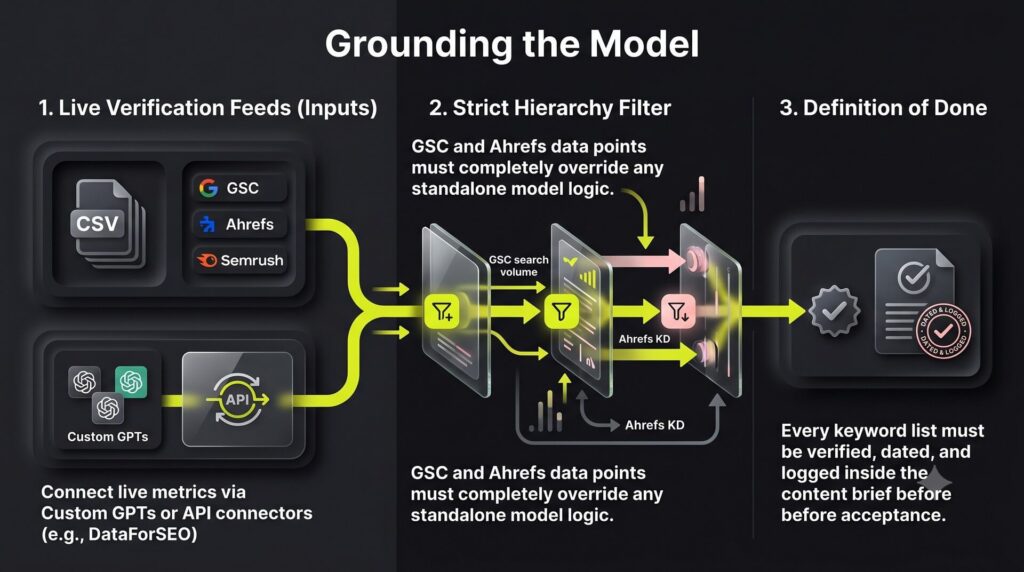
LLMs excel at logic but fail at real-time accuracy. Static knowledge produces confident, incorrect answers for time-sensitive chatgpt seo. Without strict governance, teams risk building roadmaps on hallucinated search volumes rather than live SERP realities.
Adopt two verified setups to ground the model. Lightweight workflows involve pasting CSV exports into the chat from:
- Google Search Console
- Ahrefs
- Semrush
Advanced operations utilize Custom GPTs or API connectors like DataForSEO to feed the model live metrics.
Maintain a hierarchy where GSC and Ahrefs data override model logic. Log every prompt and output within content briefs to track strategic decisions. The definition of done requires keyword lists to be verified and dated before acceptance. This ensures strategies are rooted in current data, not AI imagination.
4. Structure Content for Retrieval and Citation
Traditional longform content is often too dense for retrieval. To dominate chatgpt seo, shift from writing to rank to engineering for extraction. This ensures your brand becomes the cited answer rather than just a search result.
On-Page Adjustments
- Add a 3 to 5 bullet TL;DR near the top for immediate crawler ingestion.
- Convert subtopics into question-based H2s that match user prompts.
- Place a concise answer paragraph (50 to 90 words) immediately after every heading.
Formatting for LLMs
LLMs prioritize specific patterns that facilitate rapid synthesis:
- Direct definitions
- Step lists
- Comparison tables
- Decision criteria
Attributing every claim to internal data or external citations builds the entity authority required for AI selection. This architecture makes pages easier to retrieve, quote, and cite without adding bloat.
5. Enforce an Intent-First Content Workflow
Generic AI drafts are a liability. Most teams fail by publishing content that ignores live SERP intent. If ChatGPT generates a broad guide when the user expects a tactical comparison, you lose. Shift intent checks to the start of your production line to prevent thin, non-ranking results.
Align production with search reality using this workflow:
- Classify the SERP type (e.g., listicle, comparison, or guide).
- Extract mandatory subtopics from the top three results.
- Feed these intent constraints to ChatGPT before drafting.
Secure your moat by adding one unique element per page, such as a proprietary framework, case study, or expert quote. This strategy ensures high-velocity production while building the entity authority required for sustainable ChatGPT SEO and GEO dominance.
6. Audit Technical Access for AI Discovery
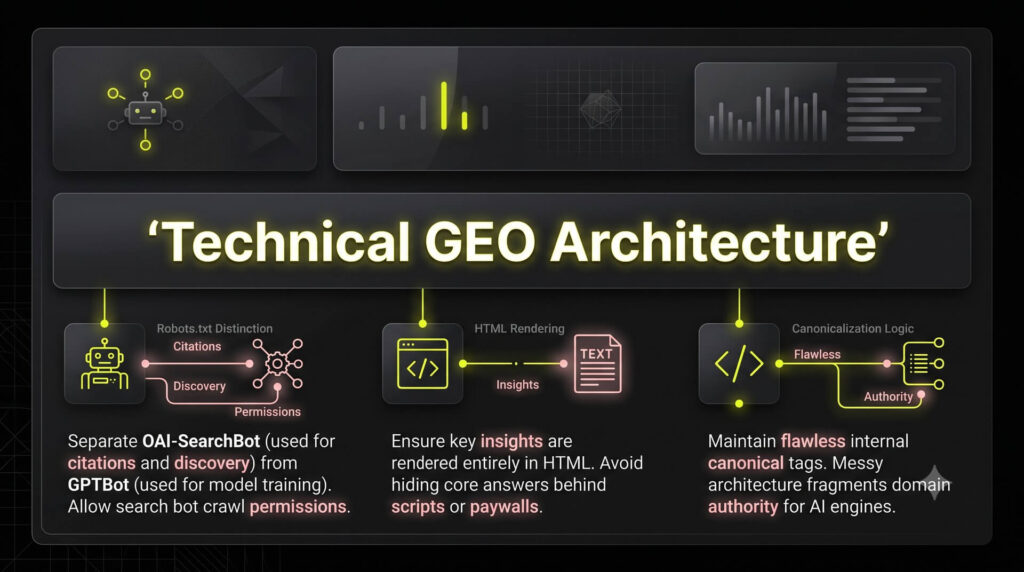
Technical GEO follows one mandate: never block discovery. If an LLM cannot retrieve your content, your brand is invisible in the answer layer. This requires deliberate crawler management and technical hygiene.
Follow this checklist to ensure citation eligibility:
- Robots.txt Rules: Distinguish between OAI-SearchBot (citations) and GPTBot (training). Blocking search bots guarantees exclusion from recommendations.
- HTML Rendering: Ensure key insights are HTML-rendered. AI retrieval systems ignore content trapped behind scripts or paywalls.
- Canonicalization: Maintain flawless internal logic. AI engines inherit your web hygiene; messy architecture fragments authority.
Separating citation indexation from training permissions secures your place in the answer pool. Proper configuration prevents accidental exclusion while protecting your data governance.
7. Build On-Page Assets for E-E-A-T and AI Citation
Generative engines ignore high-quality content that lacks verifiable authority. To earn citations, your priority pages must function as machine-readable entities that LLMs can map and trust.
Optimize service and comparison pages with these high-value assets:
- Author attribution: Include specific credentials and credibility markers that verify subject matter expertise.
- Schema deployment: Implement Organization and Service schema to define core business functions for crawlers.
- Entity clarity: Use consistent naming and “what we do” statements to reinforce internal topical clusters.
Replace vague claims with measurable data including specific timeframes, ranges, and methodology notes. This precision reduces ambiguity and increases your eligibility for AI recommendation. For expert implementation support, visit NUOPTIMA’s GEO services (https://www.nuoptima.com/geo-services) at nuoptima.com.
8. Measure GEO with Pipeline-Ready KPIs
Most teams rely on anecdotal screenshots, but you cannot scale a strategy on vibes. To transform chatgpt seo into a managed channel, track these core KPIs:
- AI Citation Share: Frequency of brand citations across targeted prompts.
- Citation Velocity: The rate of mention growth following content updates or PR.
- AI Referral Traffic: Direct clicks from LLM responses where measurable.
Operationalize this by tracking a fixed set of 20 high-intent queries weekly. Tag test pages and log every update to correlate specific optimizations with citation shifts.
When reporting to leadership, bypass vanity metrics. Frame visibility as a pipeline hypothesis where higher-intent discovery improves conversion rates. This rigor moves GEO from a speculative experiment to a predictable growth lever and a defended investment.
9. Prevent Quality Loss with an AI Risk Matrix
ChatGPT is not bad for SEO. The risk lies in misused automation and a lack of governance. To scale without sacrificing entity authority, apply a pragmatic risk matrix to your AI workflows.
- High Risk: Mass-generating pages without review or verification. This creates thin content that Google ignores and LLMs cannot cite.
- Medium Risk: AI drafts that ignore current SERP intent or buyer psychology.
- Low Risk / High Value: Ideation, outlining, drafting schema, and mapping internal links.
Governance is non-negotiable. Every AI-assisted page requires a human editor accountable for claim verification and unique data. This ensures your content provides the specific insights required for search dominance. To implement SEO and GEO without quality loss, partner with NUOPTIMA for GEO services.
Where this fits in your MSP growth system
This is one piece of how NUOPTIMA makes MSPs and cybersecurity firms the provider buyers find on Google and in AI search. See how it connects to GEO and AI-search and answer engine optimization, or get your free MSP lead forecast to see exactly where your firm shows up across ChatGPT, Gemini, and Perplexity today.